





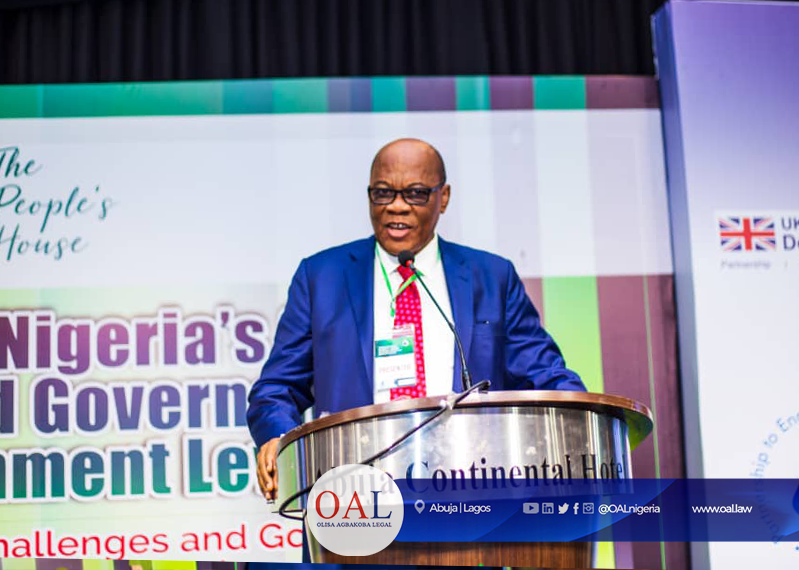
Dr. Olisa Agbakoba, a former President of the Nigerian Bar Association and Senior Advocate of Nigeria (SAN), has expressed a significant concern regarding the structure of governance in Nigeria. On a Monday statement, he emphasized the urgent need for a redistribution of powers within the nation’s three arms of government—executive, legislative, and judiciary. According to Agbakoba, the current over-centralization of authority in Abuja hinders effective governance, economic growth, and equitable national development. He highlighted that many critical decisions affecting the populace are being made far removed from local realities, resulting in discontent and inefficiencies that stifle innovation and development at the state and local levels.
Linking his advocacy for governance reform to the ongoing controversy surrounding a proposed tax reform bill, Agbakoba pointed out that while the bill aims to target corporate entities and wealthier individuals, its revenue-sharing formula was met with resistance, particularly from Northern Nigeria. The Northern regions have raised concerns about discrepancies in the revenue-sharing formula as compared to that of oil revenue. Agbakoba stressed that these valid concerns underscore the broader issue of Nigeria’s centralized governance system, which, in his view, fails to accommodate the diverse economic realities and interests of the different regions. This centrally concentrated decision-making, he argued, not only breeds dissatisfaction but also exacerbates regional inequalities and economic disparities.
Agbakoba called for a critical shift towards devolving political and revenue-collection powers to states and local governments. He contended that empowering these lower levels of government would foster a more innovative and development-oriented approach to local issues. His assertion reflects a belief that the current model, which emphasizes revenue sharing, prevents states from fully leveraging their resources for self-sustaining economic growth. By transitioning to a system that promotes revenue generation at local levels, Nigeria could achieve a more equitable distribution of resources and enhance overall national development.
Using the North’s agricultural sector as a case study, Agbakoba highlighted the potential for generating significant revenue through agricultural mechanization, which remains largely untapped due to insufficient incentives and support from the central government. He pointed out that the Northern states have the capacity for agricultural output that could transform the economy if given the proper legislative and fiscal autonomy to implement and benefit from innovative agricultural practices. He argued that without the devolution of power, the region’s agricultural potential will continue to stagnate, thereby denying a critical opportunity for economic growth and development.
Furthermore, Agbakoba criticized the federal government’s involvement in local issues such as marriage registration, driver’s licenses, and basic education, suggesting that these responsibilities should be managed at the state or local level. He expressed bewilderment at the federal oversight of such community-centric matters, asserting that it reflects a significant overreach that limits the ability of local governments to function effectively and attend to their constituents’ needs. The centralized nature of these governance issues leads to inefficiencies and an uneven distribution of resources and powers, which ultimately undermine local governance capabilities.
Lastly, Agbakoba’s call for judicial reform also warrants attention. He recommended that the judiciary, particularly the Supreme Court, consider decentralizing its jurisdiction to reduce delays in case resolutions. He noted that the Supreme Court currently handles excessively local jurisdictional matters that are better suited for state or local courts. The delays in judicial proceedings due to this overburdened system further exemplify the need for power redistribution, ensuring that justice is administered timely and efficiently. Therefore, Agbakoba argues that a comprehensive restructuring of the governance framework is imperative for Nigeria to advance towards a more effective, efficient, and equitable system of governance that can respond to the diverse needs of its citizenry.








