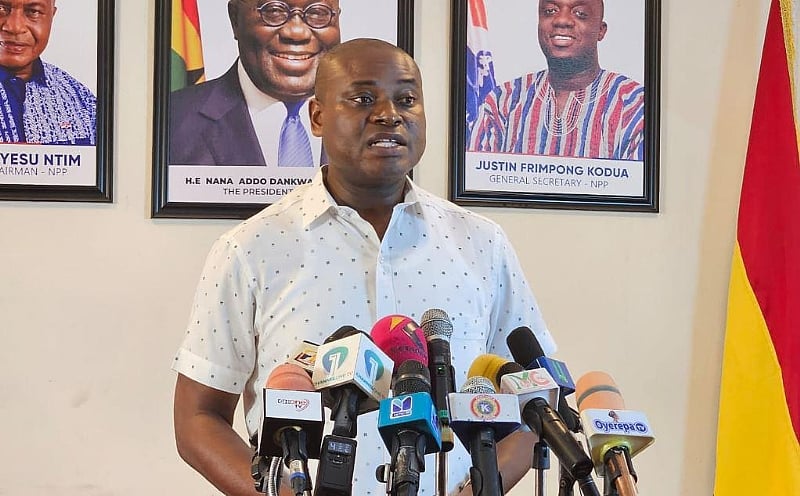
The political landscape in Ghana has been ignited by a contentious decision by the outgoing National Democratic Congress (NDC) government to dismiss employees recruited after the December 7, 2024, elections. This move has sparked a heated debate, with the New Patriotic Party (NPP), the incoming administration, vehemently criticizing the decision and invoking divine retribution against the NDC. Richard Ahiagbah, the NPP’s National Communications Director, has been particularly vocal, condemning the dismissals and labeling them an act against God and the affected individuals. He argues that the NDC’s actions are not only unjust but also set a dangerous precedent for future transitions of power. This controversy highlights the complexities and sensitivities surrounding government appointments during election periods and the potential for political maneuvering to influence staffing decisions.
Ahiagbah’s core argument rests on the principle of constitutional legitimacy. He contends that any action taken by a sitting president within their constitutional term, which spans from January 7 to December 6, remains valid and should be respected by subsequent administrations. He insists that the NDC’s attempt to nullify these appointments is a blatant disregard for this principle and undermines the integrity of the governance process. Furthermore, he emphasizes the human cost of these dismissals, portraying the affected individuals as innocent victims who simply answered the call to serve their country. By framing the issue in moral terms, Ahiagbah seeks to garner public sympathy and portray the NDC as callous and indifferent to the plight of ordinary citizens.
To bolster his argument, Ahiagbah draws a parallel with the NPP’s conduct following the 2016 elections. He points out that the NDC made several appointments, including key positions in institutions like the National Commission for Civic Education (NCCE), the Commission on Human Rights and Administrative Justice (CHRAJ), and the Audit Service, just days before leaving office. Despite these last-minute appointments, the NPP, upon assuming power, chose to honor them, respecting the decisions of the previous administration. He also cites the NDC’s decision to increase the national service allowance shortly before the transition, a decision that imposed a financial burden on the incoming NPP government. Despite this, the NPP upheld the increase, demonstrating, according to Ahiagbah, a commitment to continuity and respect for established procedures.
In contrast to the NPP’s actions in 2016, Ahiagbah argues that the NDC’s current move demonstrates hypocrisy and a lack of principle. He accuses the NDC of applying double standards, willingly accepting late appointments made by a previous government while simultaneously rejecting similar appointments made by their own administration just weeks before leaving office. This inconsistency, he asserts, undermines the NDC’s credibility and exposes their actions as politically motivated rather than grounded in genuine concern for good governance. By highlighting this perceived hypocrisy, Ahiagbah attempts to paint the NDC as acting out of self-interest and disregard for the welfare of the affected employees.
The NDC, however, has offered a different perspective on the matter. Felix Kwakye Ofosu, the Minister of Government Communications, defended the dismissals, arguing that the appointments in question were tainted by irregularities. He claims that proper procedures, including interviews and vetting processes, were bypassed in many cases, leading to questionable appointments based on political patronage rather than merit. This explanation suggests that the NDC’s decision was motivated by a desire to rectify these irregularities and ensure that government appointments are made based on established criteria, not political expediency.
This clash of narratives highlights the inherent tension between political transitions and the management of government personnel. While the NPP emphasizes the need for continuity and respect for decisions made by a legitimate government, the NDC focuses on the importance of upholding proper procedures and addressing potential irregularities. This disagreement underscores the challenges faced by incoming administrations when dealing with appointments made by their predecessors, particularly when those appointments occur close to an election. The controversy raises fundamental questions about the balance between respecting the prerogatives of a sitting government and ensuring the integrity of the appointment process. The situation calls for a clear and transparent framework to guide future transitions and minimize the potential for such disputes. This framework should outline clear guidelines for appointments during election periods, specify the powers of incoming administrations to review such appointments, and establish mechanisms for addressing potential irregularities while safeguarding the rights of affected employees.