





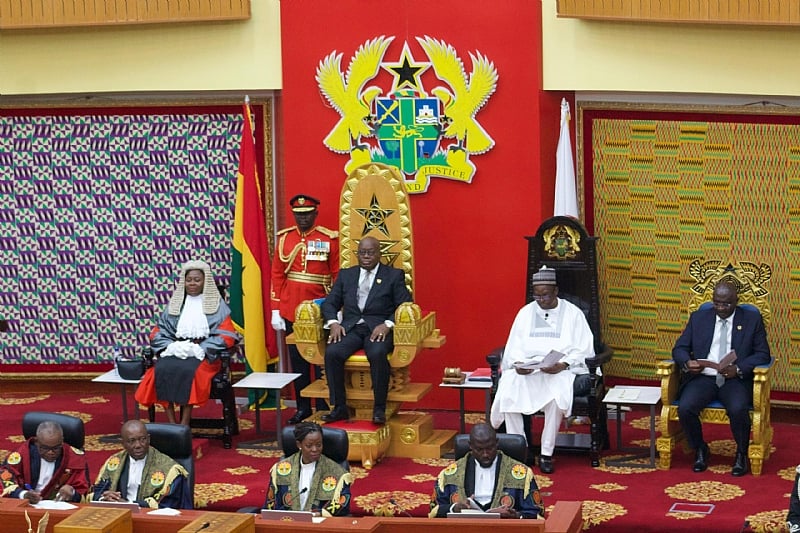
President Nana Akufo-Addo, in his final State of the Nation Address, highlighted his administration’s successful management of Ghana’s energy sector, emphasizing the containment of legacy debt and the avoidance of a projected financial crisis. He underscored that the energy sector legacy debt remained at $2.5 billion, the same level inherited by his government, effectively preventing a potential surge to $12.5 billion, as predicted by the Energy Sector Recovery Programme (ESRP) developed in conjunction with the World Bank. This achievement, he attributed to strategic negotiations with Independent Power Producers (IPPs), coupled with prudent financial management and targeted interventions that stabilized the sector and ensured uninterrupted power supply. He confidently asserted that the energy sector had undergone a significant transformation under his leadership, leaving a solid foundation for future generations.
The President emphasized the successful aversion of a looming energy sector crisis. The ESRP, a collaborative effort between the Ghanaian government and the World Bank, had projected a dramatic escalation of the energy sector debt to $12.5 billion within five years if decisive action was not taken. Such a scenario, President Akufo-Addo explained, would have crippled the sector, eroded investor confidence, and plunged the nation into widespread power outages. His administration, recognizing the gravity of this potential crisis, adopted a proactive approach involving tough negotiations with Independent Power Producers, coupled with stringent financial management practices and targeted intervention strategies. This proactive approach, he declared, successfully stabilized the energy sector and kept the lights on throughout his tenure.
A key aspect of the President’s address was the emphasis on maintaining a consistent electricity supply. The successful management of the energy sector, he noted, had not only prevented a financial meltdown but also ensured a continuous power supply for the nation. This achievement, he underscored, was a testament to the effectiveness of the government’s strategies and the dedication of those involved in the implementation of the Energy Sector Recovery Programme. He further expressed his satisfaction in leaving office with the lights on, signifying the stability and reliability achieved within the energy sector during his administration.
Expanding on the improvements in the energy sector, President Akufo-Addo highlighted the significant progress made in increasing electricity access across the country. He reported that the electricity access rate had increased to 88.85%, a substantial improvement from the 79.3% he inherited at the beginning of his term. This expanded access, he noted, brought electricity to more homes and businesses, fostering economic growth and improving the quality of life for a larger segment of the Ghanaian population. This achievement, he added, reflects the government’s commitment to ensuring equitable access to essential services for all citizens.
Furthermore, the President highlighted advancements in renewable energy, aligning with Ghana’s commitment to sustainable development. He pointed to several completed projects, including a 4-megawatt floating solar PV plant at Bui, a 15-megawatt solar PV plant at Kaleo, and a 100-megawatt solar PV plant under construction at Bui. These projects, along with the mini-grid electrification program in Ada East, he explained, were significant steps towards achieving Ghana’s target of 10% renewable energy by 2030. These initiatives demonstrate the government’s commitment to diversifying the energy mix, reducing reliance on traditional fossil fuels, and embracing cleaner energy sources for a more sustainable future.
In conclusion, President Akufo-Addo’s final State of the Nation Address presented a positive outlook on the state of Ghana’s energy sector. He emphasized the avoidance of a potential financial crisis, the maintenance of a consistent power supply, increased electricity access, and strides in renewable energy development. These achievements, he attributed to strategic planning, prudent financial management, and successful negotiations within the sector. He expressed confidence that the foundation laid by his administration would serve the nation well in the years to come, ensuring energy security and contributing to sustainable development. He reiterated his satisfaction in leaving office “with the lights on,” symbolizing the stability and progress achieved in the energy sector during his tenure.








