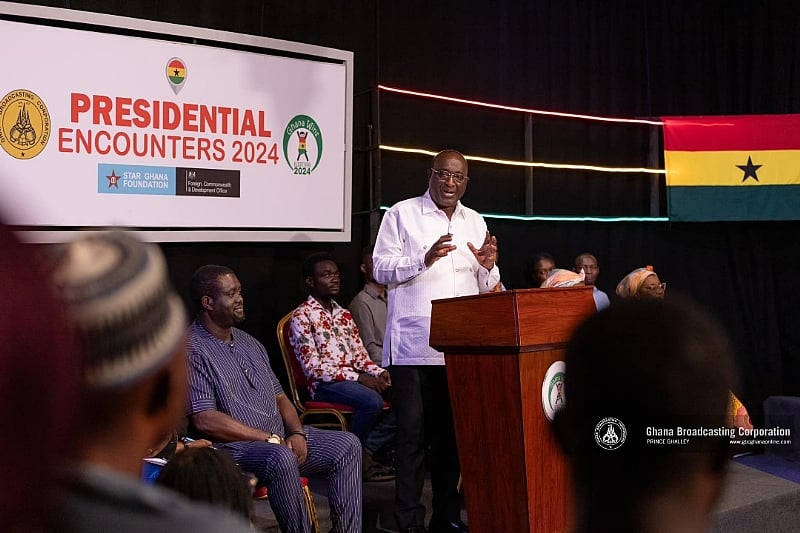
Alan Kyerematen has vocally criticized the excessive powers currently vested in the President under Ghana’s Constitution, calling these powers unacceptable and promising to implement reforms that would redistribute authority more equitably. In a statement made during the Presidential Encounters hosted by the Ghana Broadcasting Corporation on November 22, 2024, Kyerematen expressed his commitment to reviewing the Constitution before he even assumes the presidency. He envisions a governance model that will significantly limit presidential influence while promoting a system of checks and balances. This reform agenda is a central part of what he terms the Great Transformational Plan (GTP), which aims to decentralize governance and enhance democratic engagement across various segments of society.
A key feature of Kyerematen’s reform ambitions is the establishment of a Second Chamber of Parliament, which would serve as a watchdog in the governance process. This body would consist of representatives from diverse groups, including traditional leaders, religious organizations, youth activists, women’s groups, business representatives, and labor unions. One essential role of this new Chamber would be to approve appointments for crucial positions such as the Chief Justice, the Electoral Commissioner, and heads of security institutions. Kyerematen underscored the problem with the current practice of presidential appointments, arguing that it compromises the independence of these vital roles. He stated, “How can you expect complete freedom for these institutions when their heads are appointed by the President?” He believes that reforming this system is critical to fostering true democracy in Ghana.
In addition to constitutional reforms, Kyerematen has made a strong pledge against corruption, which he views as a significant impediment to Ghana’s progress. His approach includes consolidating existing anti-corruption legislation and creating an independent anti-corruption body with prosecutorial powers. He emphasized the necessity of separating this body from the Attorney General’s Office to maintain its integrity and effectiveness. To ensure this independence, Kyerematen proposed that the anti-corruption Czar should be appointed by the new Second Chamber rather than being a direct appointment of the President. He strongly criticized the inefficacies in the current anti-corruption framework, arguing that the intertwining of the Attorney General’s responsibilities undermines accountability and independence, which are essentials in combating the pervasive culture of corruption.
Kyerematen did not hold back in his critique of the existing political landscape, particularly targeting the National Democratic Congress (NDC) and the New Patriotic Party (NPP). He accused both parties of perpetuating a corrupt system for their political gain, alleging that their lack of genuine commitment to fighting corruption has exacerbated the issue. Kyerematen vehemently stated, “Corruption remains rife because the NDC and NPP governments are not genuinely interested in fighting it,” which he claims has left the citizenry to suffer the ramifications of their inaction. Furthermore, he pointed to the galamsey crisis (illegal mining) as an area where both parties have failed to act decisively due to vested interests that prevent real reform, arguing that this has resulted in a stunted growth trajectory for the country.
Another critical aspect of Kyerematen’s proposals is his intent to reform Article 257 of the Constitution, focusing on the management and distribution of natural resources. He believes that traditional authorities should be recognized as co-trustees of such resources, suggesting that the current arrangement under the Minerals Commission—where licenses are issued without consulting local chiefs—is fundamentally flawed. By involving traditional leaders in these critical discussions, he argues that the management of resources will be more just, balanced, and in line with the interests of local communities. His administration’s approach represents a shift towards a more inclusive governance model, which he considers essential for sustainable development and community empowerment.
Kyerematen has also drawn attention to the inequities present in the current compensation system for public officials as outlined in Article 71. He criticized the preferential treatment received by a limited group of officials compared to the significant number of dedicated public servants, such as teachers and health workers, who retire with minimal benefits. He stated, “How can we justify these benefits when teachers, health workers, and others who serve for decades retire on paltry pensions?” By advocating for a thorough review of these provisions, Kyerematen seeks to establish fairness and equity in the public compensation system, ensuring that all workers feel valued for their contributions to national development.
Ultimately, Alan Kyerematen’s vision, encapsulated in his Great Transformational Plan (GTP), aims to address deep-rooted systemic challenges within Ghana’s governance framework. His focus on constitutional reforms, anti-corruption measures, and equitable resource management all converge toward a common goal: building a fairer, more accountable, and participatory government that empowers citizens. He insists that his pursuit of the presidency is not about accumulating power for himself but about sharing it with the people and institutions that will solidify Ghana’s democratic foundations. This commitment to reform and inclusivity demonstrates Kyerematen’s broader aspirations for a transformative and just political future for Ghana.