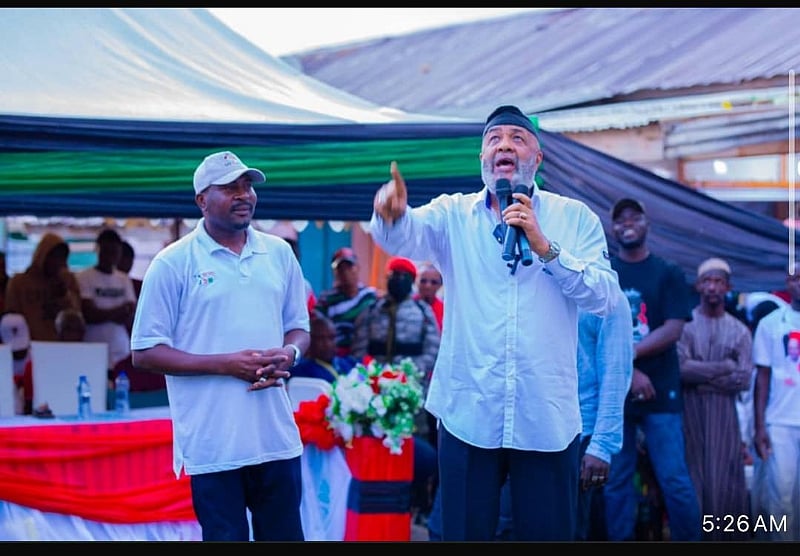
Alhaji Said Sinare, a prominent figure in Ghanaian politics, has asserted that the New Patriotic Party (NPP)’s governance has been a significant burden on the Ghanaian populace. His critique encompasses a broad spectrum of policy areas, focusing primarily on economic mismanagement, social hardship, and a perceived decline in democratic values. Sinare argues that the NPP’s economic policies have failed to deliver the promised prosperity, instead leading to increased debt, rising inflation, and a devaluation of the Ghanaian cedi. He points to the rising cost of living, escalating fuel prices, and increasing unemployment as evidence of the NPP’s inability to manage the economy effectively. He contends that these economic woes have disproportionately impacted ordinary Ghanaians, pushing many further into poverty and widening the gap between the rich and the poor.
Sinare’s critique extends beyond economic policy to encompass social issues. He argues that the NPP’s social interventions have been inadequate and poorly targeted, failing to address the fundamental needs of the most vulnerable segments of society. He cites concerns about access to quality healthcare, education, and affordable housing as key areas where the NPP has fallen short. He further criticizes what he perceives as a decline in social cohesion and an increase in polarization under the NPP’s leadership, arguing that their policies have exacerbated existing social divisions and fostered a climate of mistrust and animosity.
Moreover, Sinare expresses concerns about the state of democracy and governance under the NPP. He alleges a shrinking of democratic space, citing instances of suppression of dissent and attacks on press freedom. He also raises concerns about corruption and cronyism, arguing that the NPP has prioritized the interests of a select few over the welfare of the broader population. He criticizes what he sees as a lack of transparency and accountability in government operations, asserting that this has eroded public trust in state institutions.
To substantiate his claims, Sinare highlights specific policy decisions and their perceived negative consequences. For example, he might point to the government’s handling of the COVID-19 pandemic, its approach to tackling unemployment, or specific infrastructure projects that he believes have been poorly managed or have not benefited the intended recipients. He might also cite specific instances of alleged corruption or human rights abuses to bolster his argument about the decline in democratic values. He could further draw comparisons between the NPP’s performance and that of previous administrations, attempting to demonstrate a relative decline in key indicators of economic and social well-being.
Sinare’s criticism likely reflects a broader sentiment among opposition figures and a segment of the Ghanaian population who feel that the NPP has not lived up to its promises. His assertions contribute to the ongoing political discourse and serve as a rallying point for those who seek a change in government. His pronouncements also serve as a challenge to the NPP to address the concerns he raises and to demonstrate the effectiveness of their policies in improving the lives of ordinary Ghanaians.
Finally, it is important to acknowledge that political discourse often involves competing narratives and interpretations of events. While Sinare presents a critical perspective on the NPP’s performance, the NPP likely has its own counter-arguments and justifications for its policies. A balanced understanding requires considering multiple perspectives and engaging with a range of evidence. Evaluating the veracity of Sinare’s claims and the effectiveness of the NPP’s policies requires a thorough examination of available data, independent analysis, and critical engagement with both government pronouncements and opposition critiques. Understanding the complexities of the Ghanaian political and economic landscape necessitates moving beyond partisan rhetoric and engaging with a nuanced and evidence-based assessment of the issues.