





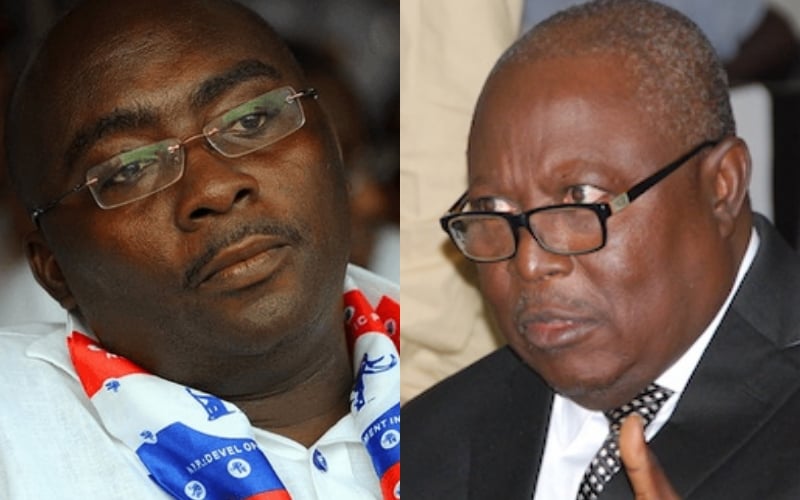
Martin Amidu, former Attorney General and Special Prosecutor of Ghana, has offered a nuanced perspective on the political future of Vice President Dr. Mahamudu Bawumia following his decisive defeat in the 2024 presidential election. While acknowledging the magnitude of the loss, Amidu suggests that Bawumia’s political career is not necessarily over, provided he undertakes a significant recalibration of his political identity and the NPP chooses to maintain its faith in him.
Amidu’s analysis hinges on the premise that Dr. Bawumia needs to disentangle himself from the shadow of President Nana Akufo-Addo. He argues that Bawumia has become perceived as a mere extension of the outgoing president, a perception that has become detrimental to his individual political standing. This perceived association, according to Amidu, has contributed to the electorate’s rejection of Bawumia’s presidential bid. The former Attorney General suggests that the eight years of the Akufo-Addo administration, characterized by what he terms “disinformation, misinformation, and rhetorical deception,” have tarnished the NPP’s image, and by extension, Bawumia’s, as he has been a key figure within the administration.
Amidu contends that for Dr. Bawumia to regain political traction, he must undergo a transformation, moving away from being seen as an “Akufo-Addo clone” and embracing the legacy of his father, Alhaji Mumuni Bawumia, a respected figure known for his integrity within the Northern Territorial tradition. This transformation, Amidu believes, would necessitate a return to core values of honesty, cultural sensitivity, and a genuine commitment to putting Ghana’s interests first. He views this as a crucial step for Bawumia to regain the trust of the electorate, who, according to Amidu, value authentic leadership rooted in traditional principles.
The decisive one-touch victory of John Dramani Mahama in the 2024 elections, according to Amidu, serves as a stark reminder of the importance of political integrity. He contrasts Mahama’s victory with the alleged deceptive practices of the Akufo-Addo administration, implying that the electorate has demonstrably rejected such tactics. Amidu sees the election outcome as a vindication of the principles enshrined in the 1992 Constitution, emphasizing that the survival of Ghana’s democratic framework relies on prioritizing genuine national interests over political expediency.
Amidu’s assessment essentially poses a challenge to Dr. Bawumia: to prove he is more than just a product of the Akufo-Addo era. He needs to demonstrate that he possesses independent political thought and a distinct vision for Ghana. This, coupled with a demonstrable commitment to the values of his father’s legacy, could potentially reshape his image and pave the way for future political success. However, even if Bawumia achieves this personal transformation, his future within the NPP remains dependent on the party’s willingness to entrust him with another leadership opportunity.
The NPP’s decision on whether to retain Bawumia as a future presidential candidate will likely depend on a multitude of factors. The party will need to assess the extent to which Bawumia can successfully distance himself from the perceived failures of the Akufo-Addo administration and regain public trust. Internal party dynamics, potential rival candidates, and the evolving political landscape will also play crucial roles in shaping the NPP’s decision-making process. Dr. Bawumia’s political future, therefore, remains uncertain, hinging on both his personal transformation and the strategic calculations of his party.








