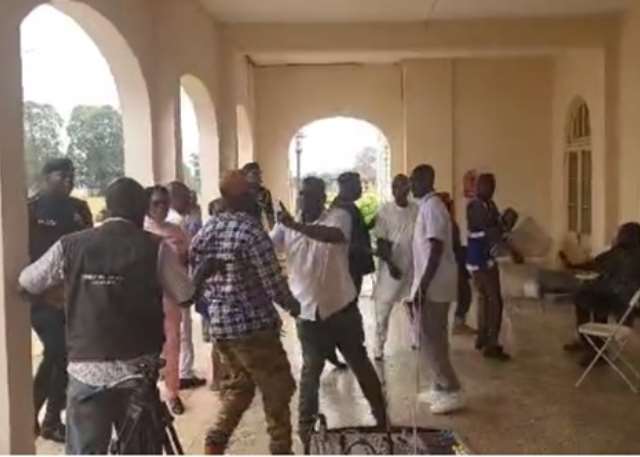
The Council of State elections in the Ashanti Region of Ghana were marred by violence and controversy, culminating in accusations against the newly appointed Regional Minister, Dr. Frank Amoakohene. Nana Nkansah Boadu Ayeboafo, a candidate for the Council of State and Chief of Agric Nzema, publicly accused Dr. Amoakohene of orchestrating the chaos that erupted during the electoral process, specifically alleging the minister’s intent to prevent him from securing a victory. The incident, which unfolded at the Regional Coordinating Council, saw a group of “machomen,” or hired thugs, assaulting several members of the media who were present to cover the vote sorting process. This violent disruption left journalists from various media outlets, including Angel, Lawson, Oyerepa, Ezra, and GhanaWeb, with injuries, forcing some to flee the scene to avoid further harm.
The alleged actions of the Regional Minister and the subsequent violence cast a shadow over the democratic process, raising concerns about the safety and security of individuals participating in elections. Nana Nkansah Boadu, in an interview with OTEC FM News in Kumasi, strongly condemned the attack, characterizing it as a disgraceful and undemocratic act. He described the scene at the Regional Coordinating Council as one of widespread fear and confusion, with many individuals left stranded and traumatized by the unexpected outbreak of violence. He emphasized the gravity of the situation by directly accusing the Ashanti Regional Minister of openly declaring his intention to obstruct his candidacy for the Council of State, a claim that further intensifies the allegations against Dr. Amoakohene.
The presence and actions of the “machomen” highlight a recurring problem in Ghanaian politics, where the use of intimidation and violence to influence electoral outcomes poses a significant threat to the integrity of the democratic process. This incident underscores the potential dangers faced by candidates and voters alike, raising questions about the effectiveness of security measures and the commitment of authorities to ensuring free and fair elections. The assault on journalists also represents an attack on the freedom of the press, hindering their ability to report on critical events and hold those in power accountable. The fact that journalists were specifically targeted during the vote sorting process suggests an attempt to suppress information and manipulate the narrative surrounding the election.
Nana Nkansah Boadu’s public accusation against the Regional Minister adds a layer of complexity to the situation, demanding a thorough investigation into the events that transpired. The allegations against Dr. Amoakohene, if proven true, would represent a serious abuse of power and a blatant disregard for democratic principles. Such actions undermine public trust in elected officials and erode the foundations of a functioning democracy. The incident calls into question the minister’s fitness for office and the need for accountability within the government. A transparent and impartial investigation is crucial to determine the extent of the minister’s involvement and to ensure that those responsible for the violence are brought to justice.
The incident at the Ashanti Regional Coordinating Council serves as a stark reminder of the fragility of democratic institutions and the constant vigilance required to protect them. The use of violence and intimidation to influence elections has no place in a democratic society. Addressing this issue requires a multi-faceted approach, including strengthening law enforcement, promoting political tolerance, and fostering a culture of respect for democratic principles. Holding those responsible for such acts accountable is essential to deter future occurrences and to send a clear message that violence and intimidation will not be tolerated.
The call for stakeholders to condemn the violence echoes the need for collective action to safeguard the integrity of the electoral process. Political parties, civil society organizations, religious leaders, and community leaders all have a role to play in promoting peaceful and transparent elections. Condemning such acts is not enough; concrete steps must be taken to address the root causes of electoral violence, including political polarization, the proliferation of small arms, and the culture of impunity. By working together, stakeholders can create an environment where all citizens can participate freely and safely in the democratic process, without fear of intimidation or violence. This incident should be a wake-up call for Ghana to strengthen its democratic institutions and ensure that future elections are conducted in a peaceful and transparent manner.