









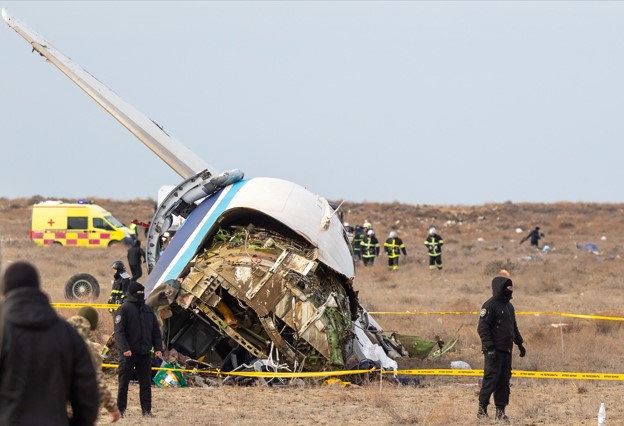
The crash of Azerbaijan Airlines flight J2-8243 near Aktau, Kazakhstan, on Wednesday, December 27th, has sparked an international investigation and fueled speculation regarding the cause of the tragedy, which claimed the lives of 38 of the 67 individuals on board. Preliminary findings from both the airline and Azerbaijan’s transport minister point towards “physical external interference” as a contributing factor, leading to suspicions that the aircraft may have been inadvertently struck by a Russian air defense system. The flight, originating in Baku, Azerbaijan, and destined for Grozny, Russia, deviated significantly from its intended course over the Caspian Sea after two unsuccessful landing attempts in Grozny.
The timing of the crash coincides with reports of Ukrainian drone attacks targeting Grozny and Vladikavkaz, as confirmed by Dmitry Yadrov, the head of Russia’s civil aviation agency. While Yadrov cited thick fog as the reason for the pilot’s aborted landing attempts in Grozny, the presence of Ukrainian drones and the subsequent diversion of the Azerbaijani aircraft raise questions about the potential role of Russian air defense systems in the incident. The Kremlin, however, has refrained from offering any official comment pending the conclusion of the investigation, a stance reiterated by Kremlin spokesman Dmitry Peskov.
Azerbaijan’s transport minister, Rashad Nabiyev, publicly stated that expert opinions and eyewitness accounts suggest external interference played a role in the crash. He emphasized the need to identify the specific type of weapon involved, citing survivor testimonies describing three explosions heard as the aircraft flew over Grozny. Azerbaijan Airlines subsequently suspended flights to ten Russian airports and issued a statement mirroring the minister’s assertion of external interference.
Supporting the theory of external involvement, both aviation and military experts have analyzed the wreckage, noting shrapnel damage consistent with a potential strike by an air defense system. Azerbaijani media outlets, including the pro-government site Caliber, have cited unnamed officials claiming that a Russian Pantsir-S1 air defense system may have been responsible for firing the missile that struck the aircraft. This allegation aligns with survivor accounts, such as that of Subkhonkul Rakhimov, who described an explosion outside the plane during the Grozny landing attempt, resulting in shrapnel piercing the fuselage.
Ukrainian President Volodymyr Zelensky has called for a thorough and transparent investigation into the crash, suggesting that visual evidence implicates Russian involvement. This call for accountability echoes the sentiments of Azerbaijani MP Rasim Musabekov, who demanded an apology, acceptance of responsibility, and compensation for the victims’ families from the Russian government. Musabekov further speculated that the aircraft’s diversion over the Caspian Sea might have been an attempt to conceal evidence related to the incident.
The unfolding investigation faces the complex task of piecing together the events leading up to the crash. Key questions remain regarding the specific nature of the external interference, the role of Russian air defense systems, and the circumstances surrounding the aircraft’s diversion. The presence of Ukrainian drone activity in the vicinity of Grozny during the incident adds another layer of complexity. While survivor testimonies and expert analysis of the wreckage provide crucial insights, a comprehensive investigation is essential to determine the precise sequence of events and ultimately establish accountability for the tragic loss of life. The international implications of this incident underscore the need for a transparent and thorough investigation to provide closure for the victims’ families and to prevent similar occurrences in the future.









