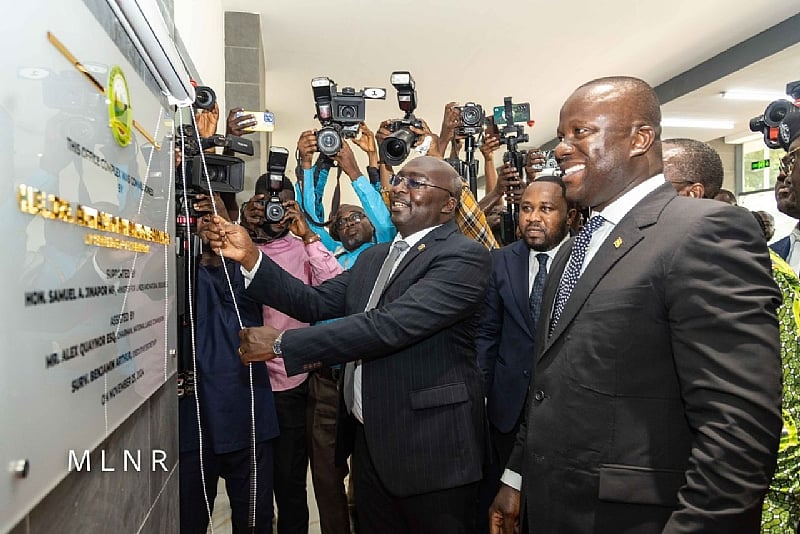
The Ghanaian government’s recent commissioning of a new head office for the Lands Commission in Accra marks a significant step toward improving land administration and management services in the country. Vice President Dr. Mahamudu Bawumia delivered an address during the official opening, emphasizing that this construction fulfills a crucial aspect of the government’s ongoing efforts to modernize the land sector. Over the past eight years, the administration has focused on reforming land services, investing in contemporary office infrastructure, digitizing processes, and ensuring that the workforce is well-trained and motivated. This new facility is equipped with advanced digital tools that facilitate the Commission’s transition from traditional, paper-based systems to more efficient digital operations, enhancing both productivity and transparency.
The Vice President underlined the land sector’s vital role in Ghana’s economy, noting that approximately 90% of the population relies on land for their livelihoods, either directly or indirectly. A robust land management system is essential for sustainable economic growth, social stability, and a conducive environment for investment. Bawumia stressed the government’s commitment to prioritizing the development of a modern land administration system to improve overall national development, stating that optimal land management practices are central to the progress of communities and cities across the country.
Minister for Lands and Natural Resources, Mr. Samuel Abu Jinapor, praised Dr. Bawumia for fulfilling the promise made in 2018 to provide the Lands Commission with a modern office consistent with the government’s digitalization agenda. He described the newly constructed facility as a symbol of the Akufo-Addo/Bawumia government’s dedication to creating a transparent and efficient land administration system that can spur economic development. Jinapor highlighted that the office will elevate standards in land service delivery, ensuring that both the Lands Commission and affiliated agencies can provide high-quality services to Ghanaians and stakeholders seeking land administration assistance.
In addition to the new head office, the Minister pointed out other significant infrastructure projects undertaken by the government in recent years. These include the commissioning of a new Regional Office for the Greater Accra Regional Lands Commission and plans to complete a new office complex for the Tema District Office soon. Furthermore, the government intends to construct twelve additional Regional Offices across the nation to enhance the working environment for Lands Commission staff, thus promoting efficient land service delivery throughout the country.
Benjamin Arthur, Executive Secretary of the Lands Commission, expressed gratitude towards the government for its support in securing the approval for a five-year land administration transformation project, which is set to begin in the first quarter of 2025. This ambitious initiative aims to establish a comprehensive and updated national digital map that would benefit all sectors of the economy. Additionally, it seeks to create a digital database of land records, develop planning schemes for registrable lands, build a robust Land Information System, and automate business processes for selected services within the Lands Commission.
In conclusion, the new head office of the Lands Commission symbolizes the extensive transformation efforts underway in Ghana’s land administration sector. The government’s commitment to modernization, underpinned by the development of digital infrastructure and enhanced operational capabilities, is expected to foster a more efficient, accessible, and transparent land management system. These initiatives are not only crucial for improving service delivery within the sector but also have far-reaching implications for the country’s economic development, social cohesion, and investment climate. Following this trajectory, the Lands Commission is poised to play a pivotal role in shaping the future of Ghana’s land administration framework, benefitting current and future generations.