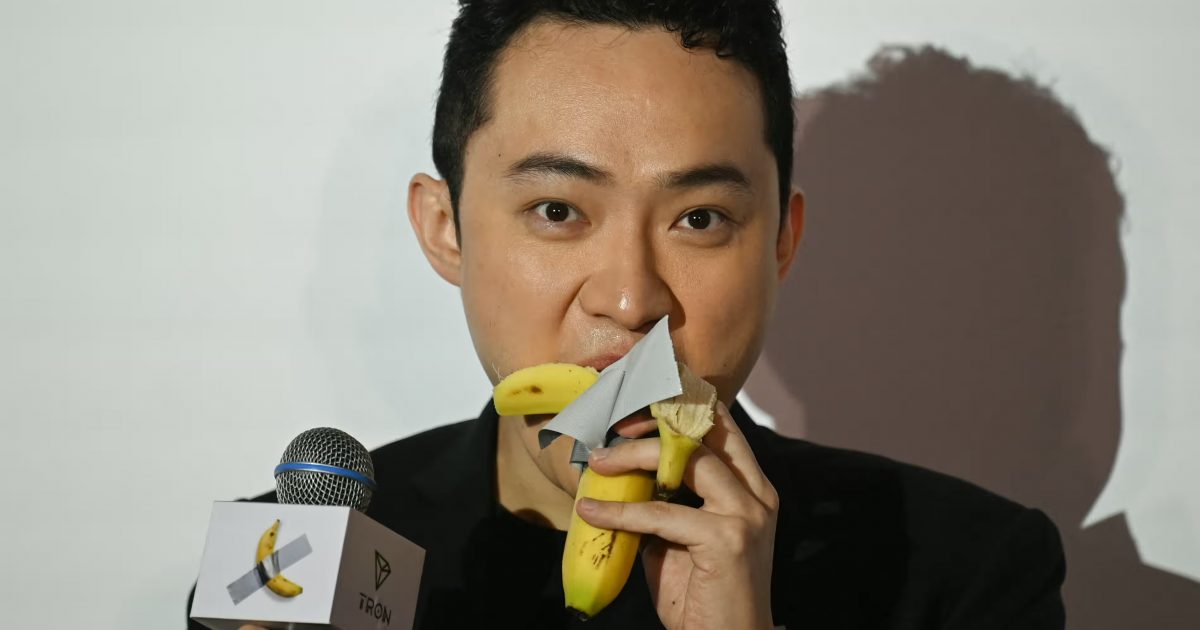
On November 30, 2024, Justin Sun, a notable cryptocurrency entrepreneur originally from China, made headlines by fulfilling his peculiar promise to consume a banana from the artwork titled “Comedian.” This controversial piece, created by artist Maurizio Cattelan in 2019, consists of a simple banana duct-taped to a wall and boasts a staggering value of $6.2 million (£4.9 million). Sun, who is known for his bold ventures in the crypto space, acquired the artwork through a competitive bidding process at a Sotheby’s auction in New York, where he outbid six other participants. The fresh banana, which served as the focal point of the artwork, could seemingly be purchased for as little as 35 cents that day, emphasizing the surreal nature of the piece’s valuation.
The saga surrounding “Comedian” has sparked endless debates about the nature of art, value, and consumerism in the modern age. By juxtaposing a commonplace object like a banana with a six-million-dollar price tag, Cattelan challenges traditional notions of what constitutes art and its worth. This performance aspect, coupled with Sun’s innovative approach to cryptocurrency and digital assets, brings an intriguing blend of contemporary art and financial speculation. In a way, Sun’s decision to eat the banana can be viewed as a statement—a reflection on the absurdity of valuing an ordinary object so exorbitantly, as well as a performative act that merges the worlds of high art and cryptocurrency culture.
As Sun took the audacious step to consume the banana, he reignited conversations around the role of investments in cultural phenomena. His actions can be seen as a commentary on how commodities are perceived in an age where digital assets often eclipse traditional forms of investment. The cryptocurrency market, characterized by its volatility and unpredictability, mirrors the whimsicality found in Cattelan’s work. Sun, being a prominent figure in the crypto community, leverages his celebrity status to draw attention to both the artwork and the peculiarities of financial markets. In this light, consuming the banana not only serves as a spectacle but also as a form of social commentary that resonates with younger investors who are increasingly experimenting with unconventional forms of investment.
Furthermore, the event attracted widespread media coverage, showcasing the intersection of art, finance, and technology. In an era where the digital world heavily influences cultural trends, Sun’s act can be seen as a strategic move to garner engagement within both the art community and the crypto enthusiasts. Social media platforms buzzed with reactions—from playful skepticism to genuine curiosity about the implications of such extravagant acts. Crucially, this event highlights how the narrative around the commodification of art has evolved, particularly as the art market becomes more intertwined with the technological advancements of the digital age.
As intriguing as the artwork and Sun’s actions are, they also raise critical questions regarding authenticity and the future of art consumption. In a world increasingly reliant on digital assets, one must ponder if the traditional definitions of art and value are shifting permanently. Just as NFTs (Non-Fungible Tokens) have changed how various art forms are bought and sold, the assimilation of physical art pieces with cryptocurrency culture points towards an evolving landscape. This might lead to further innovations as well as broader disruptions within both industries, as artists and investors explore new methods to define and monetize creativity and culture.
In conclusion, Justin Sun’s consumption of the banana from Cattelan’s “Comedian” serves as an exaggerated yet insightful exploration of contemporary art and modern finance. His act opens up discussions about the contradictions inherent within both systems, simultaneously blurring the lines between value, culture, and consumption. As the art world continues to grapple with its identity amid the digital revolution, and as cryptocurrency remains a driving force of economic change, events like these underline the importance of questioning established norms and perceptions. The unfolding narrative promises to be as unpredictable as the assets it represents, inviting new interpretations and explorations in the realm of art and investment.