









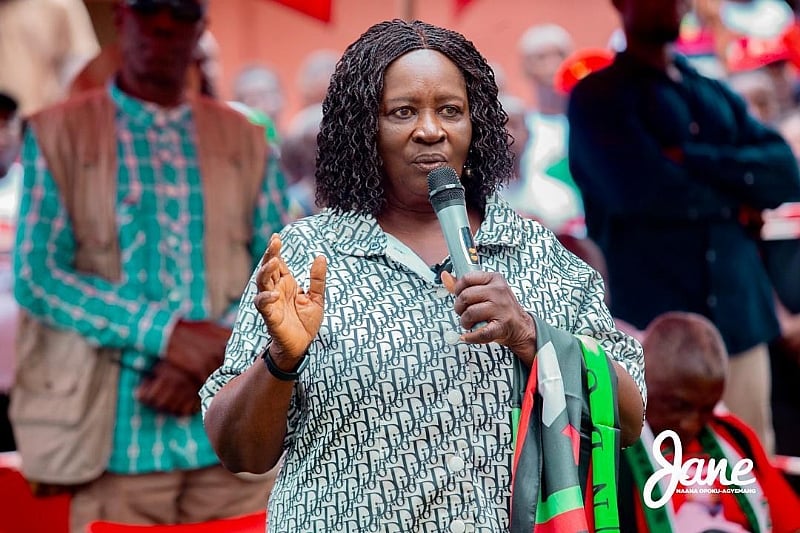
In a passionate campaign address at Adiembra Zezera in the Dormaa West Constituency, Prof. Jane Naana Opoku-Agyemang, the Vice Presidential Candidate of the National Democratic Congress (NDC), emphasized the importance of prioritizing developmental needs over other considerations as Ghanaians prepare for the upcoming December 7, 2024 elections. Highlighting the NDC’s extensive record in fostering development across various sectors, she noted the tangible improvements in health, education, road construction, electricity access, water supply, markets, and aviation during the party’s previous tenure in government. Prof. Opoku-Agyemang underlined the NDC’s commitment to infrastructure investment, recalling the promise to build 200 secondary schools, which became a reality during their time in office until 2017.
Further, the vice-presidential candidate drew a stark comparison between the NDC’s accomplishments and the promises made by the ruling New Patriotic Party (NPP), which had pledged to construct 350 new schools. She challenged the NPP to disclose their progress in fulfilling these promises and called for accountability regarding the government’s track record in bettering the lives of Ghanaians. Addressing the electorate, she emphasized that elections are fundamentally about evaluation, urging voters to look critically at the achievements and failures of the incumbent government before making their choice.
Prof. Opoku-Agyemang also cautioned voters to be vigilant against what she described as “temporary inducements” from the ruling party, which may be aimed at securing votes through short-term incentives while neglecting fundamental developmental needs. She characterized these tactics as a longstanding approach of the NPP, manifesting a disconnect between the government’s promises and the lived realities of Ghanaians. In her view, the lack of visible progress in essential infrastructure such as education and transportation serves as evidence of this neglect.
In framing the upcoming elections as a crucial opportunity for change, Prof. Opoku-Agyemang urged voters to place their trust in the NDC’s presidential candidate, Mr. John Dramani Mahama. She posited that a vote for Mahama would not only signify a desire for a return to progressive governance but would also pave the way for comprehensive development across the country. To this end, she highlighted key policies proposed by Mahama, such as the Big Push initiative aimed at expanding job opportunities, the National Apprenticeship Programme, the Women’s Development Bank to foster female entrepreneurship, and a robust 24-hour economy designed to stimulate economic activity.
The core of her message resonated with a call for a principled approach to voting, where citizens are urged to prioritize their developmental aspirations and hold political leaders accountable for their promises. By fostering a sense of civic responsibility among the electorate, Prof. Opoku-Agyemang hopes to engender a renewed spirit of democratic engagement that goes beyond transactional politics. Her campaign, grounded in the achievements of the NDC and a shared vision for future development, underscores the importance of informed decision-making as Ghanaians head towards election day.
In conclusion, Prof. Jane Naana Opoku-Agyemang’s campaign reinforces a strong message of accountability and commitment to development within the framework of democratic elections. She invites the electorate to reflect on the tangible benefits of the NDC’s past governance and to remain cautious of short-term incentives that may distract from long-term developmental goals. By placing a bet on Mahama’s leadership, she is advocating for a collective effort to reinvigorate Ghana’s progress across all sectors, ensuring that the needs of the people remain at the forefront of political discourse in the lead-up to the elections.









