









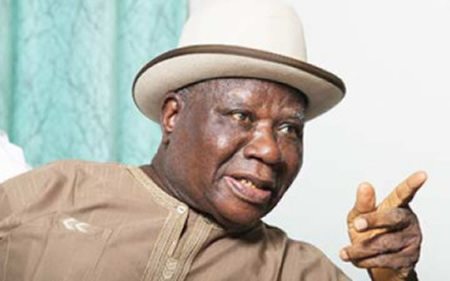
Chief Edwin Clark, a prominent elder statesman and leader of the Ijaw nation, has voiced serious allegations against former President Muhammadu Buhari and former Attorney-General Abubakar Malami regarding the treatment of former Chief Justice of Nigeria, Walter Onnoghen. In a letter addressed to current Chief Justice Kudirat Kekere-Ekun, Clark asserts that Buhari orchestrated Onnoghen’s removal from office to manipulate and undermine the electoral process during the critical 2019 presidential elections. Clark commended the recent Court of Appeal judgment that acquitted Onnoghen of accusations related to false asset declarations, calling it a long-overdue triumph for justice after years of perceived humiliation and oppression inflicted on Onnoghen by the previous administration.
Clark emphasized the constitutional framework that restricts the power to appoint and suspend the Chief Justice of Nigeria (CJN) to the President, the National Judicial Council, and the National Assembly. This assertion underscores his criticism of Buhari’s actions as unlawful. Clark recoils at the implications that former President Tinubu should permit unaccounted powers or ‘sacred cows’ to influence governance, highlighting that no individual, regardless of their position, should be insulated from legal scrutiny. He points out that while presidents enjoy temporary immunity while in office, there’s a distinct absence of lifelong immunity from legal accountability in Nigerian law.
The Ijaw leader recounted how Onnoghen was treated unfairly, calling the removal “disgraceful, callous, unjust, and barbaric.” Clarke argues that Buhari’s motivations were self-serving because Onnoghen’s integrity posed a potential obstacle to the administration’s questionable electoral machinations. Clark contends that Onnoghen’s removal was a strategic maneuver by Buhari and Malami, who allegedly feared that Onnoghen would not condone or endorse any electoral misconduct during the presidential elections. He postulates that the conspiracy was deeply intertwined with Buhari’s ambition for a second term, which resulted in Onnoghen bearing the brunt of political animosities.
Clark criticized the apparent lack of response from key legal bodies, such as the Nigerian Bar Association and the National Judicial Council, during the tumultuous period leading to Onnoghen’s exit from the judiciary. He was optimistic about the recent Court of Appeal outcome, which led to Onnoghen’s acquittal, and expressed joy in seeing justice served after the tumultuous and unjust treatment he alleged Onnoghen endured. In his address, Clark reminded Nigerians of their shared citizenship, emphasizing the need for equal protection under the law and encouraging Onnoghen to continue advocating for his rights against systemic injustices.
In response to Clark’s remarks, Garba Shehu, a former senior aide to Buhari, remained silent on the issue. However, an anonymous official from the previous administration offered a defense for the suspension of Onnoghen, asserting that it was legally justified due to allegations of not declaring assets, as legally mandated. This official remarked that the procedural decisions adhered to the established constraints of Nigerian law regarding asset declarations and the potential consequences of failing to do so. It was posited that the legal structure provided the necessary framework for either prosecution or dismissal based on the determinations made under the law.
Despite varying interpretations of the previous administration’s legal justifications, Clark’s vehement assertions signify ongoing tensions regarding judicial independence and accountability in Nigeria. The allegations bring into sharp focus the sometimes contentious intersection between politics, justice, and individual rights in Nigeria’s democracy. Clark’s call for accountability reflects deeper public sentiments towards the necessity of legal fairness and consequences for past political misdeeds, advocating for a nation where justice prevails equitably for all citizens, urging Tinubu’s administration to heed these lessons to foster a more just political climate.









