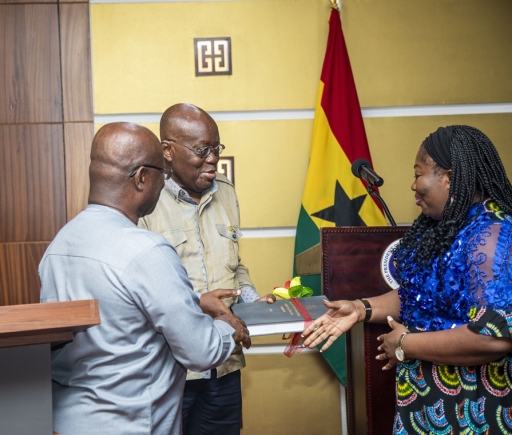
The Constitutional Review Consultative Committee (CRCC) in Ghana has presented its report to President Nana Addo Dankwa Akufo-Addo, recommending a cap on the size of Parliament at 277 elected members. This proposal aims to amend Articles 47 and 93 of the 1992 Constitution, establishing a definitive upper limit on the number of constituencies and parliamentarians. The committee’s recommendation stems from a meticulous review of various constitutional review submissions, proposals, and reports from institutions like KNUST, IEA, University of Ghana School of Law, UPSA, and GIMPA, including the significant 2011 report of the Constitution Review Committee (CRC).
The CRCC’s rationale for proposing 277 as the maximum number of parliamentarians is rooted in pragmatism and the desire to avoid political acrimony. Reducing the number below the current 276 constituencies would necessitate scrapping some constituencies. This, the committee argues, would inevitably lead to political disputes, as parties would likely favor eliminating constituencies dominated by their opponents. Maintaining the status quo, with a slight increase to an odd number (277), provides a less contentious solution. This approach avoids the potentially divisive process of selecting constituencies for elimination, preserving political stability and focusing on the broader constitutional review process.
The committee’s recommendation underscores the importance of balancing representation with efficiency and cost-effectiveness in parliamentary governance. While a larger parliament might seem to offer broader representation, it also comes with increased financial burdens and potential complexities in legislative processes. By setting a cap, the CRCC aims to create a more streamlined and potentially more effective legislature without drastically altering the existing representative structure. This approach acknowledges the existing political landscape and seeks to make improvements without triggering disruptive realignments.
The CRCC’s recommendation to cap the size of Parliament also reflects a broader trend towards optimizing legislative bodies for efficiency and effectiveness. Globally, there are ongoing debates about the ideal size of parliaments, considering factors like population size, geographic representation, and the nature of the political system. While some argue for larger parliaments to ensure diverse representation, others advocate for smaller, more agile bodies that can facilitate efficient decision-making. The Ghanaian context adds another layer to this debate, emphasizing the need to consider political sensitivities and the potential for destabilization when altering constituency boundaries.
The proposal to amend Article 47 also clarifies the role of the Electoral Commission in determining constituencies. By explicitly stating that the commission shall prescribe the constituencies, the amendment reinforces the commission’s authority in this matter, while simultaneously establishing the 277-member limit as a non-negotiable constraint. This clear demarcation of responsibilities aims to prevent future ambiguity and potential conflicts regarding the delineation of constituencies.
The CRCC’s report represents a significant step in the ongoing constitutional review process in Ghana. The recommendation to cap the size of Parliament at 277 members is a pragmatic approach that balances the need for representation with the imperative for efficient and cost-effective governance. By avoiding the potentially divisive process of reducing the number of constituencies, the committee seeks to promote political stability and focus on other crucial aspects of constitutional reform. The proposal, now in the hands of the President, awaits further consideration and potential implementation, which will undoubtedly shape the future landscape of Ghanaian politics and governance.