





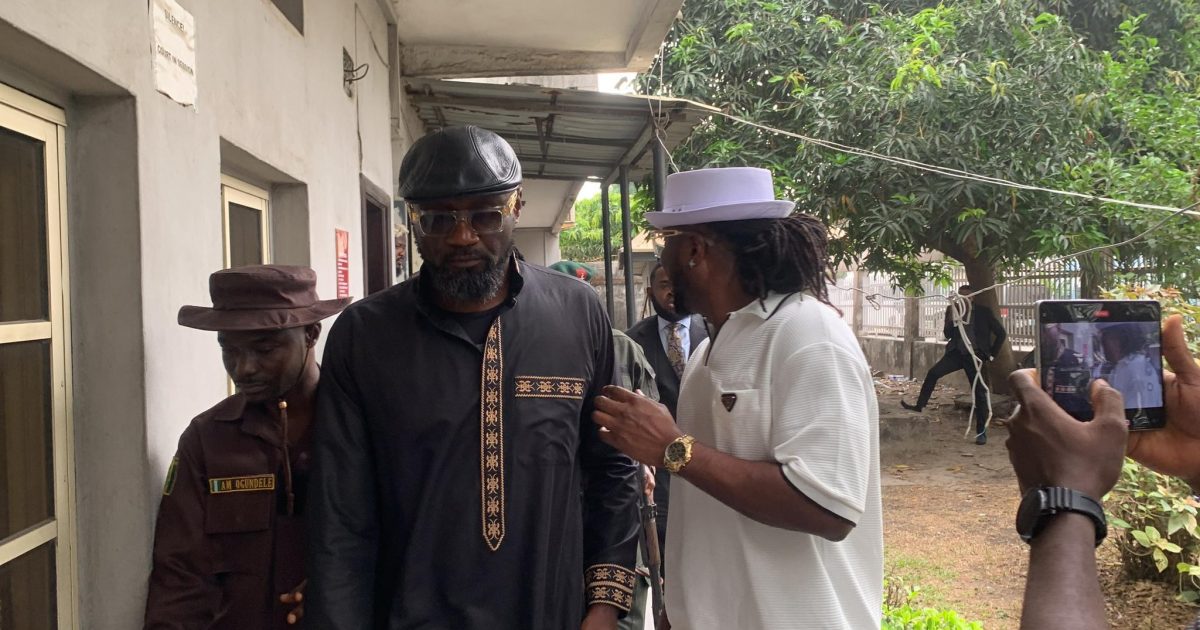
Jude Okoye, the former manager of the renowned music group P-Square, found himself entangled in legal proceedings at the Special Offences Court in Ikeja, Lagos, facing allegations of theft exceeding $1 million and £34,000. The charges, brought forth by the Economic and Financial Crimes Commission (EFCC), stemmed from alleged misappropriation of royalties generated from digital music distribution and publishing between 2016 and 2023. Okoye, along with his company, Northside Music Limited, was arraigned on March 4, 2025, on four counts relating to the purported theft and conversion of the funds. The prosecution asserted that these actions violated sections 278 and 285 of the Criminal Laws of Lagos State, 2011.
The legal battle unfolded as Okoye’s defense team, led by Clement Onwuenwunor (SAN), filed a bail application on February 27, 2025. The application was heard on March 6, 2025, and Justice Oshodi subsequently granted bail to Okoye in the sum of N50 million. The bail conditions stipulated two sureties of the same amount, residing within the court’s jurisdiction, and providing evidence of three years’ tax payment. Furthermore, Okoye was required to surrender both his Nigerian and St. Kitts and Nevis passports to the court’s registrar, with the EFCC tasked with notifying immigration authorities to prevent their use pending the case’s resolution.
This case at the Special Offences Court ran concurrently with another legal challenge faced by Okoye at the Federal High Court. He was facing a separate seven-count charge before Justice Alexander Owoeye. In that case, he had been granted bail on Monday in the sum of N100 million, also requiring two sureties in like sum. The overlapping legal proceedings underscored the complexity of the accusations against Okoye and the significant financial implications involved.
During the bail hearing at the Special Offences Court, Onwuenwunor argued that the dispute was essentially a civil matter, characterizing it as a disagreement between directors and a family feud. He proposed that Okoye’s younger brother, Paul Okoye, known professionally as Rudeboy, be accepted as a surety. The prosecution, represented by Mohammed Bashir, countered this assertion by highlighting the seriousness of the charges and the substantial evidence against Okoye. They argued that the multiple charges and Okoye’s dual citizenship posed a flight risk, potentially leading him to abscond. The prosecution also questioned the absence of medical evidence to support claims of ill health presented by the defense.
Justice Oshodi, in his ruling, acknowledged the prosecution’s concerns about Okoye’s dual citizenship and the potential for him to evade trial. However, after considering the arguments and affidavits presented by both sides, he granted bail with the stringent conditions outlined. The judge’s decision reflected a balance between the need to ensure Okoye’s appearance in court and the principle of presumption of innocence. The case was adjourned until May 16 and 23, 2025, for trial.
The legal proceedings against Jude Okoye underscore the intricate nature of financial disputes within the entertainment industry. The alleged misappropriation of significant royalties, coupled with Okoye’s dual citizenship, created a complex legal landscape. The court’s decision to grant bail with substantial conditions reflects the judiciary’s attempt to navigate the competing interests of upholding the law, ensuring the defendant’s accountability, and respecting the presumption of innocence until proven guilty. The upcoming trial will delve further into the evidence and determine the validity of the charges against Okoye and his company.








