





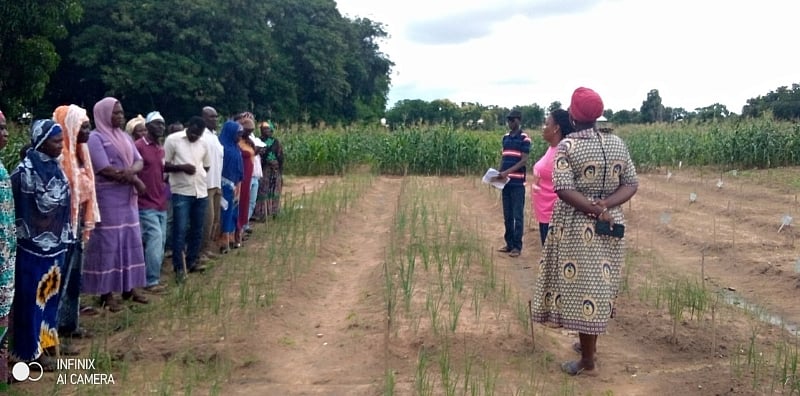
The Upper West region of Ghana, traditionally not known for significant onion production, is poised for a transformation into a major onion cultivation hub, thanks to the efforts of research scientists at the Council for Scientific and Industrial Research Savannah Agricultural Research Institute (CSIR-SARI-Wa). While some onion farming exists, particularly around Karni in the Lambusie District, the region has not embraced large-scale commercial onion production. CSIR-SARI-Wa is spearheading this change by empowering local farmers with knowledge and skills in Good Agricultural Practices (GAP) to achieve international market competitiveness and generate valuable foreign exchange for Ghana. This initiative directly addresses the perception among some farmers that the region is unsuitable for onion cultivation, a misconception dispelled by CSIR-SARI-Wa’s demonstration farms showcasing the success of onion varieties like ‘Idol’ and ‘Texas Tropical’.
The approach taken by CSIR-SARI-Wa emphasizes farmer ownership and adoption of sustainable agricultural practices. Through seasonal training sessions, research scientists equip farmers with the necessary knowledge and value-addition techniques for resilient onion production. This is crucial, as onion, despite being a major vegetable crop in West Africa, has not received the attention it deserves in the Upper West region. Unlike the Northern and Upper East regions, where onion cultivation is widespread, particularly with the ‘Bawku red’ and ‘Gilma’ varieties, the Upper West region has lagged behind. CSIR-SARI-Wa’s introduction of ‘Idol’ and ‘Texas Tropical’ onions, coupled with practical field demonstrations, is designed to bridge this gap and encourage farmers to adopt these high-yielding, climate-smart varieties.
The success of the demonstration farms hinges on effective knowledge transfer and practical application. Dr. George Yakubu Mahama, an agronomist and head of division at CSIR-SARI-Wa, encourages farmers, especially women, to approach farming as a business, leveraging the new onion varieties and the support provided by CSIR-SARI-Wa to improve their financial standing. Mr. Hashim Ibrahim, an assistant research scientist, meticulously guides farmers through the intricacies of onion cultivation, including experiments with organic and inorganic fertilizers at varying application rates. These trials demonstrate the optimal fertilizer strategies for maximizing yields of ‘Idol’ and ‘Texas Tropical’ onions. The farmers also learn about these varieties’ early maturity and climate resilience.
The training goes beyond agronomy and encompasses crucial aspects of farm economics and soil science. Dr. Iddrisu Yahaya, an agricultural economist, stresses the importance of crop budgeting, cost-benefit analysis, and understanding the economic potential of onion cultivation, citing its value as a food source, income generator, and for its various medicinal properties. Mr. Opoku Godwin, a soil scientist, emphasizes the importance of soil testing before planting any crop, urging farmers to embrace large-scale onion farming as a viable business opportunity, especially given Ghana’s significant onion imports from neighboring countries. This highlights the potential for import substitution and economic growth within the region. Mr. Asieku Yahaya, another agronomist, reinforces the potential for women to significantly boost their incomes through onion cultivation, emphasizing the importance of the GAP project for overall crop production success in the region.
The impact of the demonstration farms is evident in the positive feedback from participating farmers. Farmers from Kpongu and surrounding villages expressed enthusiasm and readiness to adopt the new agricultural technologies, recognizing their potential for personal and regional economic development. Remarkably, some farmers encountered onion plants for the first time during these demonstrations, underscoring the novelty of this initiative. This sparked considerable interest in large-scale onion production, inspired by the success of neighboring countries like Niger and Burkina Faso. This suggests a shift in mindset towards recognizing the potential of onion cultivation as a lucrative agricultural venture.
The success story of this project is captured by the testimony of Madam Sherifa Daud, a female farmer from Kpongu, who expresses gratitude to the organizers and the research scientists. She expresses confidence that, with the support of CSIR-SARI-Wa, farmers in the Upper West region will embrace the new onion varieties and transform the region into a leading onion producer and exporter, both nationally and internationally. This optimistic outlook highlights the potential for a significant agricultural and economic shift in the Upper West region, driven by the adoption of new technologies, scientific research, and the empowerment of local farmers. The project promises not just increased onion production but also improved livelihoods and economic growth for the region.








