



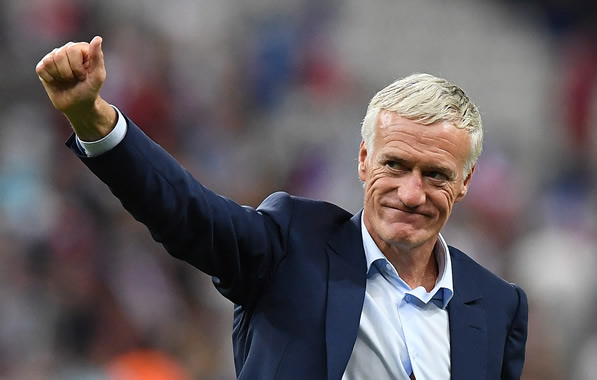
Didier Deschamps, the mastermind behind France’s 2018 World Cup triumph, has officially declared his intention to remain at the helm of the French national team until the 2026 World Cup. This announcement, made during an interview with French broadcaster TF1, puts to rest any speculation about his future and confirms his commitment to leading Les Bleus through another World Cup cycle. Deschamps, who took over the reins in 2012, has overseen a period of remarkable consistency and success for the French team, culminating in their second World Cup victory in Russia. His decision to extend his tenure through 2026 underscores his unwavering dedication to maintaining France’s position among the world’s footballing elite.
Deschamps’ journey with the French national team has been one of remarkable achievements. His tenure began in 2012, inheriting a team grappling with internal divisions and inconsistent performances. He quickly instilled a sense of unity and purpose, transforming the squad into a formidable force on the international stage. The pinnacle of his coaching career came in 2018 when he guided France to World Cup glory in Russia, orchestrating a thrilling campaign that showcased the team’s attacking prowess and defensive solidity. While the 2022 World Cup in Qatar resulted in a heartbreaking penalty shootout defeat to Argentina in the final, Deschamps’ leadership was instrumental in navigating a challenging tournament and reaching the final stage.
The 2026 World Cup, jointly hosted by the United States, Mexico, and Canada, will mark the culmination of Deschamps’ long and illustrious association with the French national team. His decision to remain in charge until then signifies his belief in the team’s potential and his desire to leave a lasting legacy. Deschamps’ understanding of the game, his tactical acumen, and his ability to inspire his players have been key factors in France’s sustained success. He has fostered a culture of excellence within the squad, demanding high standards and instilling a winning mentality. The 2026 World Cup will provide him with another opportunity to showcase his coaching prowess and guide France to further glory.
Deschamps’ remarkable achievements as both a player and a coach have solidified his place among footballing legends. As captain, he led France to their first World Cup victory on home soil in 1998, etching his name into French footballing folklore. His subsequent transition to management has been equally impressive, culminating in another World Cup triumph in 2018. This rare feat places him in an exclusive club alongside Mario Zagallo of Brazil and Franz Beckenbauer of Germany, both of whom also achieved World Cup success as both players and coaches. Deschamps’ continued leadership, combined with the emerging talent within the French squad, suggests that Les Bleus will remain a force to be reckoned with on the international stage, with their sights set firmly on reclaiming the World Cup trophy in 2026.
The extension of Deschamps’ contract through 2026 provides stability and continuity for the French national team. His deep understanding of the players, his tactical flexibility, and his proven ability to manage high-pressure situations make him the ideal candidate to lead France into the next World Cup cycle. The challenges ahead will be significant, with a growing number of competitive nations vying for international honors. However, Deschamps’ experience, coupled with the wealth of talent at his disposal, provides grounds for optimism. The 2026 World Cup represents another opportunity for Deschamps to cement his legacy as one of the greatest figures in French football history.
Deschamps’ announcement also provides clarity and allows the French Football Federation to plan for the future with confidence. Knowing that the leadership position is secure allows for a focused approach to player development, scouting, and tactical preparation. The 2026 World Cup will be a unique tournament, hosted across three nations and featuring an expanded format. Deschamps’ experience in navigating complex tournaments will be invaluable as France aims to adapt to the new challenges and maintain its position as a global footballing powerhouse. His continued leadership provides a sense of stability and purpose, setting the stage for another exciting chapter in French football history.