









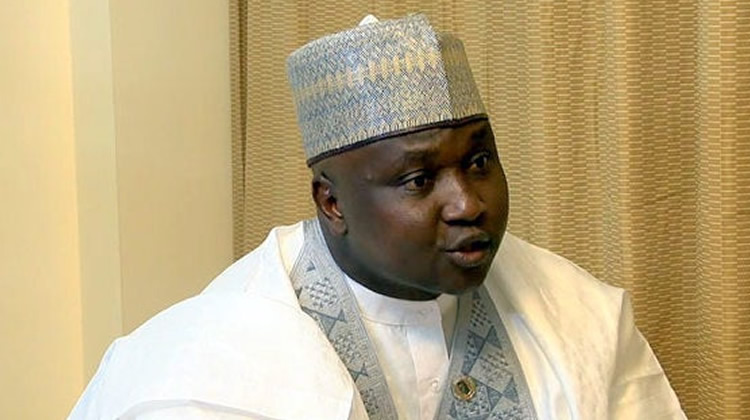
Alhassan Ado-Doguwa, a member of the Nigerian House of Representatives, found himself embroiled in a political controversy following his remarks at the 2024 Ede Day celebrations in Osun State. Representing House Speaker Tajudeen Abass, Ado-Doguwa’s comments were interpreted as praising the incumbent governor, Demola Adeleke, a member of the opposing People’s Democratic Party (PDP), and seemingly undermining his own party, the All Progressives Congress (APC). This sparked immediate backlash from the Osun APC chapter, accusing Ado-Doguwa of de-marketing the party and inadvertently bolstering the PDP’s standing in the state.
Ado-Doguwa swiftly moved to clarify his stance and apologize for the perceived slight. He issued a statement attributing the controversy to the PDP’s deliberate manipulation of his words for political gain, aiming to exploit any perceived division within the APC ranks. He reiterated his unwavering commitment to the APC, emphasizing his role as a staunch advocate for the party throughout the nation, including Osun State. Ado-Doguwa insisted that his original comments were misconstrued and never intended to disparage the APC or its prospects in the state.
The incident underscores the intensely competitive political landscape in Osun State, where the APC and PDP are locked in a continuous power struggle. Ado-Doguwa’s appearance at the Ede Day celebrations, a significant cultural event, offered a platform for political maneuvering. His seemingly complimentary remarks about Governor Adeleke, interpreted as an acknowledgement of the PDP’s current dominance, ignited concerns within the APC about potential internal divisions and the impression of conceding ground to the opposition.
Ado-Doguwa’s apology served as an attempt to mitigate the damage and reassure the Osun APC of his loyalty. He portrayed the controversy as a calculated move by the PDP to capitalize on an ambiguous situation and sow discord within the opposing ranks. His plea for forgiveness highlighted the sensitivity of the situation and the importance of maintaining party unity, particularly in a state as politically volatile as Osun. He further reinforced his commitment by expressing confidence in the APC’s resurgence in the 2026 elections, indicating a determination to regain lost ground and reaffirm the party’s strength.
This incident also highlights the significance of carefully crafted political messaging and the potential for misinterpretation, especially in a charged political environment. Ado-Doguwa’s experience serves as a cautionary tale, illustrating how seemingly innocuous statements can be weaponized by political rivals to create narratives that serve their interests. The rapid dissemination of information through various media channels can amplify such controversies, necessitating swift and decisive responses to clarify one’s position and minimize potential damage.
In the broader context of Nigerian politics, this episode reflects the complex interplay between national and local political dynamics. Ado-Doguwa, a national figure representing the House Speaker, found himself navigating the intricacies of local politics in Osun State. His attempt to balance his national role with the sensitivities of local political rivalries inadvertently sparked a controversy that required careful management. This incident underscores the importance for political figures operating on the national stage to remain cognizant of local political landscapes and to calibrate their messaging accordingly to avoid unintended consequences. The episode also serves as a reminder of the ever-present potential for political maneuvering and the need for vigilance in interpreting and responding to potentially divisive narratives.









