





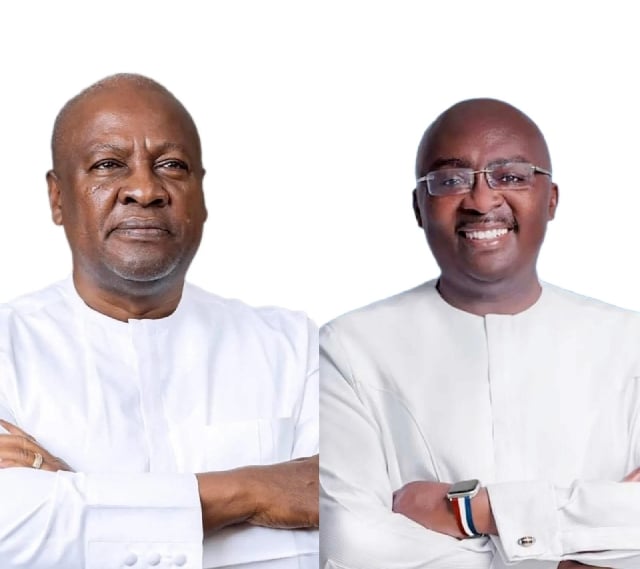
Mussa Dankwah, the Executive Director of Global InfoAnalytics, has boldly predicted that former President John Dramani Mahama of the National Democratic Congress (NDC) will achieve a significant victory in the upcoming 2024 general elections in Ghana. Dankwah asserts that Mahama will win outright in the first round of voting, negating the possibility of a runoff, and additionally anticipates that the NDC will gain a parliamentary majority. This prediction indicates a strong resurgence for Mahama, positioning him favorably ahead of the elections scheduled for December 7. Dankwah’s confident stance presents a stark contrast to other political analyses currently shaping the electoral landscape.
In stark opposition to Dankwah’s projections, Prof. Smart Sarpong, Director of Research and Innovation at Kumasi Technical University, has released data indicating a different trend in public sentiment towards the New Patriotic Party (NPP). According to Sarpong’s findings, Dr. Mahamudu Bawumia, the NPP’s presidential candidate, enjoys a lead in popularity with 49.1% of voter support as compared to Mahama’s 45.8%. These figures suggest that the NPP might maintain its parliamentary majority, raising the likelihood of a runoff election should no candidate attain the required threshold for an outright victory. This divergence in polling results underscores a tightly contested electoral race, with both major political parties rallying their supporters as the election date nears.
Mr. Dankwah’s survey reflects a more optimistic outlook for the NDC, indicating that Mahama has garnered 51.9% voter support, leaving Bawumia behind at 40.5%. This degree of confidence in Mahama’s capabilities and the NDC’s prospects suggests a significant shift in voter sentiment that could reshape the political dynamics in Ghana. As both candidates prepare their campaigns to resonate with the electorate, the contrasting predictions of their respective political fates elevate the suspense surrounding the elections. The predictions are consequential, not merely for the candidates involved but for the broader narrative of Ghanaian politics, which is characterized by intense competition between the two leading parties.
The political atmosphere in Ghana is charged with anticipation, and these varying poll results reflect a complex interplay of factors influencing voter behavior. Among these factors are the candidates’ campaign strategies, public perception of their governance records, and the socio-economic conditions affecting the populace. The divides in opinion among experts indicate a lack of consensus on key issues and highlight the potential for shifts in public opinion as election day approaches. As uncertainty looms, the potential for an unexpected electoral outcome adds to the excitement and tension within both the electorate and the parties contesting the election.
Furthermore, the implications of these predictions extend beyond the immediate electoral contest. Should Mahama secure a decisive victory as predicted by Dankwah, it would signify a notable return to power for the NDC, potentially impacting policies and governance priorities in Ghana. On the other hand, if Sarpong’s forecast holds true and the NPP maintains both the presidential and parliamentary seats, it would reinforce the status quo and might lead to shifts in legislative priorities reflective of the NPP’s platforms. Each outcome carries weight, not only for the leading political figures but for the citizens whose lives are intricately tied to the decisions made by their elected officials.
As the Ghanaian electorate prepares for the forthcoming elections, these predictions highlight the unpredictable nature of politics and the importance of continuous engagement between candidates and voters. The evolving political landscape necessitates that candidates remain agile in their campaign messages and responsive to the constituents’ needs. Voter turnout will ultimately play a pivotal role in determining the outcome, underscoring the importance of grassroots mobilization and effective communication strategies in the days leading up to the election. With fervent campaigning and heightened political activity expected, the final results on December 7 will be closely watched, marking a crucial moment in Ghana’s democratic journey.








