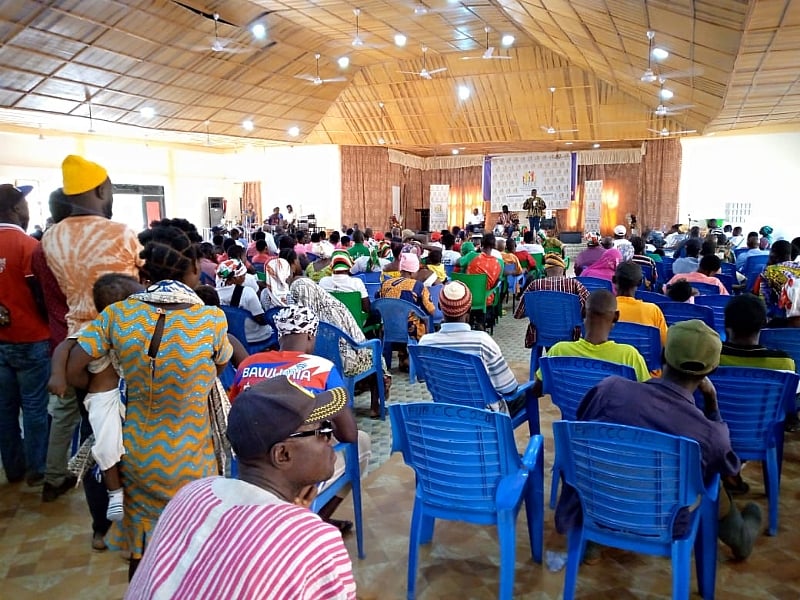
In an impressive showcase of participatory democracy, the National Commission for Civic Education (NCCE) organized a vital political dialogue in Builsa South District on November 20, 2024. This event served as a significant platform where parliamentary candidates could communicate directly with voters, expressing their visions for the district. The gathering, held at the Fumbisi Church of Pentecost Auditorium, saw the participation of around 350 individuals, including students, traditional leaders, and persons with disabilities, as well as representatives from various institutions. Moderated by Rev. Fr. Michael and Pastor Joseph Azuimah, the forum placed strong emphasis on tolerance, active engagement, and informed decision-making in the lead-up to the upcoming elections, setting a constructive atmosphere for dialogue.
The event began with an opening prayer, which set a reverent tone, subsequently followed by an introduction of dignitaries and a welcome speech from the district NCCE director, Mrs. Caroline Aliko. Pognaab Hajia Comfort Akantoa, Chairperson of the Inter-Party Dialogue Committee (IPDC), reiterated the importance of active participation and mutual tolerance among attendees to create an environment conducive to meaningful discussions. The moderators underlined that this gathering was meant to promote dialogue rather than debate, encouraging candidates to use both English and local languages for inclusivity. This approach enabled a seating arrangement based on a secret ballot, facilitating fair representation of the candidates from different political parties.
With education being a central focus of the dialogue, all candidates presented their past achievements and future plans to enhance learning in the district. Hon. Dr. Clement A. Apaak of the NDC highlighted his proactive steps, including the construction of Doninga Primary School and significant contributions towards the educational needs of students, promising further support. Hon. Christopher Akamzedeboka of the PNC reflected on completed projects, including teacher accommodations that aim to enrich educational experiences. Hon. Daniel A. Gariba, representing the NPP, commended his party’s focus on education and outlined his contributions toward getting top-performing students into tertiary education.
Addressing concerns regarding the absence of tertiary institutions, Dr. Apaak assured attendees of plans to establish an agricultural college in the district to enhance skills and foster rural development. Candidates also highlighted various strategies for poverty alleviation, with Akamzedeboka discussing the construction of market stalls for local traders, while Gariba emphasized his commitment to expanding the LEAP program. Dr. Apaak also revealed a sponsorship initiative benefitting two students from every town in the district to promote educational empowerment among youth.
Healthcare emerged as a pivotal topic during the discussion, with candidates putting forth their contributions and future healthcare initiatives. Dr. Apaak spoke on his financing of a children’s ward at the Fumbisi District Hospital and ongoing efforts to enhance rural electrification. Gariba discussed the NPP’s Agenda 111 initiative and the expansion of district hospital facilities, emphasizing the need for consistent healthcare service delivery. Akamzedeboka highlighted his party’s efforts in securing a power plant for the Fumbisi hospital among other health projects. The common agreement among candidates regarding the pressing infrastructural challenges in the district was noteworthy, wherein they shared individual and collective efforts to improve accessibility, particularly concerning road construction delays attributed to contractual inefficiencies.
The event also included a highly interactive Q&A session, where attendees engaged directly with candidates, addressing pressing concerns surrounding health and education financing. Critical needs from health workers and educators emerged, such as requests for an anesthetic machine and additional space for maternity services, illustrating the urgent requirements in healthcare infrastructure. The dialogue attracted a diverse audience, including traditional authorities, education professionals, and local students. This highlighted the community’s commitment to civic participation, with the event efficiently emceed by Aunt Kony, who ensured audience engagement remained high throughout.
Overall, the political dialogue significantly underlined the candidates’ dedication to development and the critical role of grassroots engagement in nurturing democratic accountability and inclusivity. As the district approaches the election period, events like these exemplify the fundamental essence of democracy—a governance system designed “by the people, for the people.” They reinforce the notion that civic engagement is pivotal for fostering a responsive and effective political landscape that addresses the constituents’ needs and aspirations.