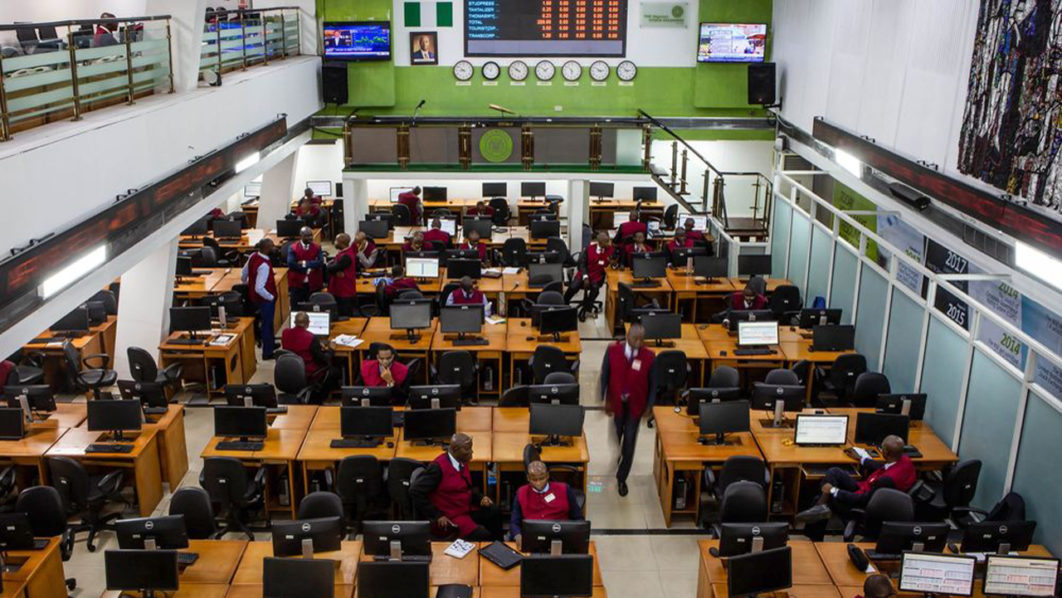
The Nigerian equity market experienced a downturn over the past week, witnessing a decline of N185 billion as the All-Share Index and Market Capitalisation fell by 0.33 percent and 0.31 percent, landing at 97,506.87 and N59.11 trillion, respectively. This decrease indicates a challenging environment for investors, reflecting a broader trend of volatility within the market. Investors on the floor of the Nigerian Exchange engaged in a total turnover of 3.194 billion shares, which were valued at N54.850 billion across 45,112 transactions. This reduced activity might hint at investor uncertainty amid a fluctuating market landscape.
The Financial Services Industry dominated the trading activity, accounting for a significant portion of the volume. With 1.509 billion shares worth N26.904 billion traded across 20,357 deals, it contributed 47.25 percent of the total equity turnover volume and 49.05 percent of the total value. Following this sector was the Construction/Real Estate Industry, where 839.945 million shares worth N4.806 billion were traded in 1,399 deals. The Oil and Gas Industry ranked third, with trading of 256.445 million shares valued at N13.307 billion across 6,313 transactions. This sectoral breakdown underlines the uneven distribution of investment activity, highlighting the Financial Services Industry’s predominance within the Nigerian equity market.
Among the most actively traded equities, Haldane McCall Plc, FBN Holdings Plc, and Japaul Gold and Ventures Plc emerged as leaders, collectively accounting for 1.587 billion shares valued at N19.797 billion from 3,632 deals. This represented a significant 49.69 percent of the total equity turnover volume and 36.09 percent of the value, showcasing the strength of these companies during an otherwise turbulent market week. Additionally, the market saw trades of 20,749 units of bonds valued at N5.281 million, indicating a diversified trading interest beyond equities.
The week also saw mixed performance among equities, with 32 gaining in value, 46 depreciating, and 75 remaining unchanged. Among the gainers, SUNU Assurances Nigeria Plc made notable gains, rising to N3.90 from N3.16, which equates to a 23.42 percent increase. Haldane McCall Plc similarly enjoyed a rise from N5.10 to N6.20, reflecting robust trading interest. However, several equities experienced significant losses, with Austin Laz & Company Plc recording the largest decline, plummeting from N2.66 to N1.96, marking a 26.32 percent decrease. Other notable decliners included John Holt Plc and Lasaco Assurance Plc, reflecting broader challenges faced by various sectors.
Despite the overall decline, there were moments of positivity, as evidenced by the market capitalisation closing at N59.3 trillion on Thursday, which followed a notable gain of N306 billion. This brief rally offers a glimmer of hope in an otherwise challenging financial landscape. Market observers may interpret this fluctuation as a typical characteristic of the equity market, where gains can follow declines, contributing to a dynamic trading environment that yearns for stability and growth.
In conclusion, the current state of the Nigerian equity market underscores the complexities investors face amid fluctuating performances across major sectors. The Financial Services Industry continues to assert its strength within the market, yet overall volatility raises questions about future trends. Stakeholders will need to remain vigilant in monitoring market dynamics, as both gains and losses have emphasized the importance of strategic investments during uncertain times. This ongoing interplay between opportunity and risk will likely shape the market’s trajectory in the weeks to come as investors search for signs of stability.