





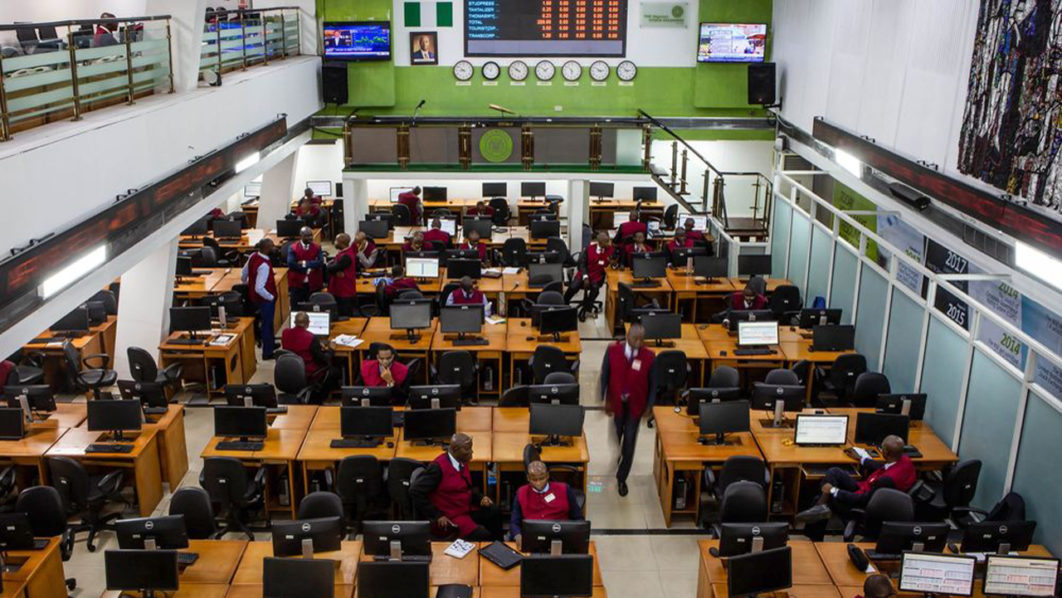
The Nigerian equity market experienced a resurgence last week, recouping previous losses and posting a significant gain of N319 billion. This positive performance pushed the All-Share Index up by 0.72 percent, closing at 98,210.75, while the market capitalization reached N59.534 trillion. This rebound signals renewed investor confidence and a potential shift towards a bullish trend in the Nigerian stock market. The increase in market capitalization reflects the overall growth in the value of listed companies, indicating a positive perception of the Nigerian economy and its future prospects. The week’s performance contrasts sharply with the preceding week’s N185 billion loss, highlighting the market’s volatility and susceptibility to both internal and external factors.
Trading activity intensified during the week, with a notable increase in both volume and value of traded shares. Investors exchanged 3.893 billion shares worth N87.749 billion in 43,868 deals. This represents a significant uptick from the previous week’s 3.194 billion shares valued at N54.850 billion traded in 45,112 deals. The increased trading activity suggests heightened investor participation and a renewed interest in the Nigerian equity market. This surge in trading volume and value could be attributed to several factors, including positive economic data, improved investor sentiment, and the attractive valuations of some listed companies. The increase in trading activity also contributes to market liquidity, making it easier for investors to buy and sell shares.
The financial services sector dominated trading activity, accounting for the lion’s share of both volume and value. A staggering 2.709 billion shares valued at N51.027 billion were traded in 20,017 deals within this sector, representing 69.58 percent of the total volume and 58.15 percent of the total value. This dominance underscores the importance of the financial sector within the Nigerian economy and its continued attractiveness to investors. The consumer goods sector followed with 403.658 million shares worth N3.844 billion, while the industrial goods sector recorded 198.360 million shares valued at N10.328 billion. The robust performance of these sectors indicates a broad-based recovery in the Nigerian economy.
Within the financial services sector, FBN Holdings Plc, Wema Bank Plc, and Fidelity Bank Plc emerged as the most traded stocks. These three financial giants accounted for a combined 1.63 billion shares worth N28.982 billion exchanged in 3,226 deals, representing a substantial 41.74 percent of total volume and 33.03 percent of the total value. The high trading volume of these stocks reflects their significant market capitalization and their popularity among investors. Their performance also serves as a barometer for the overall health of the financial services sector and the broader Nigerian economy.
The market witnessed a significant shift in the performance of individual stocks. A total of 51 stocks appreciated in value, a marked increase from the 32 recorded in the previous week. Conversely, the number of declining stocks decreased to 30 from 46 the week before. The number of stocks that remained unchanged also decreased slightly to 72 from 75. This positive trend in stock performance suggests a growing optimism among investors and a potential for further market growth. Golden Guinea Breweries Plc led the gainers with a remarkable 45.95 percent increase, followed by Sunu Assurances Nigeria Plc at 29.49 percent. On the other hand, Learn Africa Plc led the decliners, experiencing an 11.75 percent drop, followed by Aradel Holdings Plc with a 10.06 percent loss.
Further bolstering market activity was the listing of the Federal Government of Nigeria Savings Bonds for November 2024 on the Nigerian Exchange Limited. These bonds, FGS NOV 2026 with a 17.440 percent coupon rate and FGS NOV 2027 with an 18.440 percent coupon rate, attracted significant investor interest. A total of N760.189 million worth of the 17.440 percent bond was issued, comprising 760,189 units, while the 18.440 percent bond saw an issuance of N2.423 billion, with 2,423,629 units. These bonds offer investors a relatively safe and stable investment option with attractive returns. The 2-year and 3-year tenors, coupled with quarterly coupon payments, provide investors with predictable income streams. The successful issuance of these bonds underscores investor confidence in the Nigerian government and the stability of the local economy. The positive performance of the Nigerian equity market aligns with the broader global trend, influenced by stronger-than-expected US economic data, which contributed to the MSCI World equity index rising by 1.1 percent week-on-week. This positive global outlook further supports the potential for continued growth in the Nigerian stock market.








