









Paragraph 1: The Federation Accounts Allocation Committee (FAAC) disbursed a total of N1.727 trillion to the three tiers of government in Nigeria for the month of November. This sum represents the distributable revenue accruing to the Federal Government, state governments, and local government areas (LGAs). The distributable revenue comprised several components, including statutory revenue, Value Added Tax (VAT) revenue, Electronic Money Transfer Levy (EMTL) revenue, and exchange difference revenue. The total distributable revenue of N1.727 trillion represents a significant portion of the overall revenue generated in November, which stood at N3.143 trillion.
Paragraph 2: Breaking down the total distributable revenue, statutory revenue accounted for N455.354 billion, while VAT revenue amounted to N585.700 billion. The EMTL contribution was N15.046 billion, and exchange difference revenue added N671.392 billion. Notably, the communiqué highlighted a substantial increase in the gross statutory revenue received in November, reaching N1.827 trillion compared to N1.336 trillion in October, representing a significant increase of N490.339 billion. In contrast, VAT revenue experienced a decline, decreasing from N668.291 billion in October to N628.972 billion in November.
Paragraph 3: The allocation of the N1.727 trillion distributable revenue saw the Federal Government receiving the largest share, amounting to N581.856 billion. State governments received a total of N549.792 billion, while local government councils received N402.553 billion. In addition, a sum of N193.291 billion, representing 13% of mineral revenue, was distributed to the eligible states as derivation revenue, reflecting the principle of resource control and compensation for the impact of resource extraction on producing states. This allocation ensures that states rich in mineral resources receive a portion of the revenue generated from those resources.
Paragraph 4: Delving into the composition of the statutory revenue allocation, the Federal Government received N175.690 billion, while the state governments received N89.113 billion. The local government councils received N68.702 billion. Similar to the overall distributable revenue, N121.849 billion, representing 13% of mineral revenue, was shared with the benefitting states as derivation revenue. This consistent application of the derivation principle underscores its importance in revenue allocation.
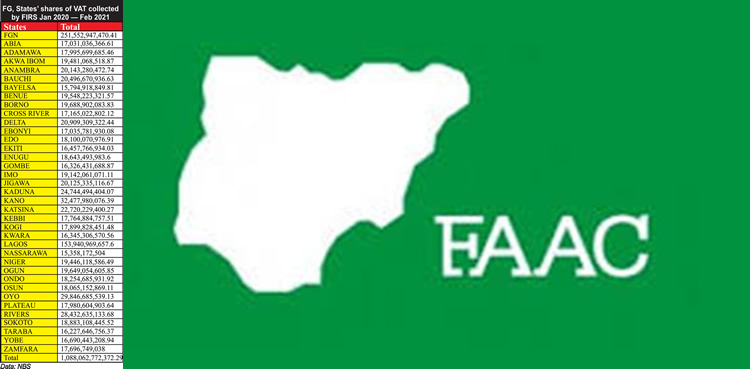
Paragraph 5: The distribution of the VAT revenue saw the Federal Government receiving N87.855 billion, while the state governments received the largest share, amounting to N292.850 billion. Local government councils received N204.995 billion from the VAT revenue. The EMTL revenue distribution saw the Federal Government receiving N2.257 billion, state governments receiving N7.523 billion, and local government councils receiving N5.266 billion. These diverse revenue streams highlight the multifaceted nature of government revenue generation in Nigeria.
Paragraph 6: The communiqué provided insights into the performance of different revenue sources in November. Oil and Gas Royalty and CET Levies recorded significant positive growth, contributing to the overall increase in revenue. Conversely, several key revenue streams experienced declines, including Excise Duty, VAT, Import Duty, Petroleum Profit Tax, Companies Income Tax, and the EMTL. Understanding these fluctuations is crucial for effective revenue management and fiscal planning. The trends observed in specific revenue sources offer valuable insights for policymakers as they seek to optimize revenue generation and ensure the sustained funding of government activities.









