









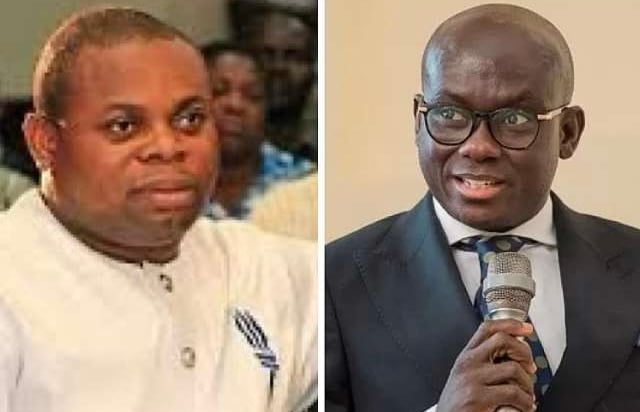
Franklin Cudjoe, the Founding President of IMANI Africa, a prominent think tank in Ghana, has publicly criticized Attorney General Godfred Yeboah Dame’s recent appeals for peace and unity following the 2024 general elections. Cudjoe’s critique centers on what he perceives as Dame’s hypocrisy, contrasting his current calls for peace with his alleged past actions of using his office to intimidate political opponents. Cudjoe argues that Dame’s newfound advocacy for peace is a direct consequence of his political party’s significant defeat in the elections and not a genuine commitment to national harmony. This public disagreement highlights the deep political divisions within Ghana and the challenges in achieving genuine reconciliation after a contentious election.
Cudjoe’s accusations stem from Dame’s tenure as Attorney General, during which he allegedly employed tactics reminiscent of the Gestapo, the secret police of Nazi Germany, to harass and suppress political rivals. Cudjoe further contends that Dame engaged in Machiavellian maneuvers to disenfranchise innocent citizens, undermining the democratic process. These accusations paint a picture of an Attorney General who prioritized political expediency over the rule of law and the rights of citizens. Cudjoe’s strong language reflects the seriousness of the allegations and the perceived damage done to Ghana’s democratic institutions.
The controversy arose after Dame’s appearance on Joy FM, a popular radio station in Accra, where he delivered a Christmas message emphasizing peace and lawful resolution of election-related disputes. Dame called on Ghanaians to recognize their shared bonds and prioritize national unity over divisive political differences. He urged for post-election issues to be addressed within the confines of the law, emphasizing the importance of due process and respect for legal institutions. His message, ostensibly aimed at promoting peace and reconciliation, was met with skepticism and criticism from Cudjoe, who viewed it as a disingenuous attempt to rewrite his own political history.
Dame’s Christmas message also underscored the significance of consolidating Ghana’s democracy. He portrayed democracy as a hard-won achievement, a system of governance to be cherished and protected. He urged Ghanaians to take pride in their democratic progress and to work towards strengthening its foundations. However, Cudjoe’s counter-narrative challenges this portrayal, arguing that Dame’s own actions have undermined the very democratic principles he now champions. This clash of perspectives highlights the ongoing debate about the health of Ghana’s democracy and the role of key political figures in shaping its future.
The core of the disagreement lies in the contrasting interpretations of Dame’s actions and motivations. While Dame presents himself as a champion of peace and democracy, Cudjoe views him as someone who abused his power to further partisan political interests. This difference in perspective reflects the deep polarization within Ghanaian society and the difficulty in bridging the divide between opposing political factions. The public exchange of accusations underscores the need for greater transparency and accountability within the government and a renewed commitment to upholding the principles of democracy.
The ongoing debate between Cudjoe and Dame raises important questions about the role of the Attorney General in a democratic society. Should the office be used to pursue partisan political agendas, or should it be a neutral arbiter of justice, upholding the rule of law for all citizens regardless of their political affiliations? Cudjoe’s critique challenges the notion of Dame as a neutral actor, portraying him instead as a partisan figure who has used his position to advance the interests of his political party. This controversy underscores the importance of ensuring that those who hold positions of power are held accountable for their actions and that the institutions of democracy are protected from political manipulation.









