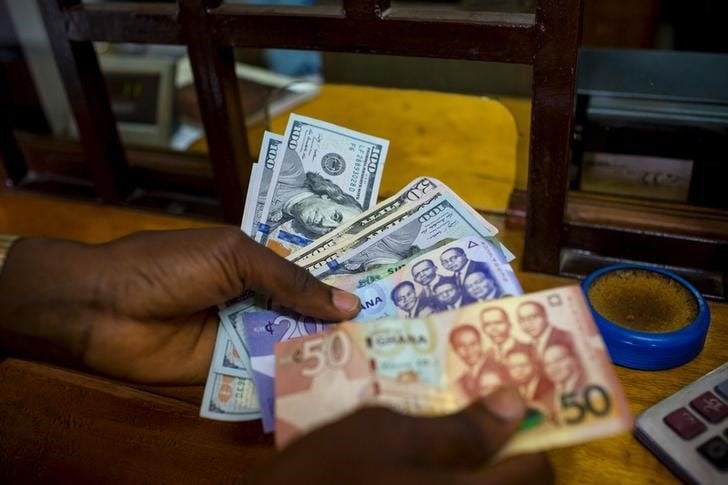
The Ghanaian Cedi has continued its positive trajectory against the United States dollar, exhibiting further appreciation in both buying and selling rates. As of Thursday, December 5, 2024, the Cedi strengthened by 12 pesewas in its buying rate and 15 pesewas in its selling rate compared to the previous day’s figures. This upward movement places the buying rate at GHS14.88 and the selling rate at GHS15.55, according to data compiled by Cedirates.com, a reliable Ghanaian platform for currency and fuel information. This sustained appreciation signals a positive trend for the Cedi, potentially indicating increased investor confidence and improved economic conditions within Ghana.
A deeper look at the interbank rates reveals a slightly different picture. At the interbank level, the Cedi trades at GHS14.91 for buying and GHS14.93 for selling against the US dollar. This marginal difference between the interbank and open market rates is typical, reflecting the varying dynamics and transaction volumes within these two distinct market segments. The interbank rate often serves as a benchmark for larger transactions between financial institutions, while the open market rate caters to a broader range of transactions, including individual currency exchanges.
The Cedi’s performance against other major currencies, such as the British Pound Sterling and the Euro, also shows a relatively stable position. The average buying and selling rates for the British Pound stand at GHS18.71 and GHS19.71 respectively, while the Euro trades at GHS15.49 for buying and GHS16.36 for selling. The Bank of Ghana’s interbank market reflects slightly different rates for these currencies, with the Pound Sterling selling at GHS18.97 and the Euro at GHS15.71. These discrepancies underscore the influence of market forces and specific trading conditions on currency valuations.
Remittance services, a crucial aspect of Ghana’s economy, offer competitive exchange rates for those sending money from abroad. Two prominent platforms, LemFi and Afriex, facilitate money transfers from the US and the UK to Ghana. LemFi offers a rate of GHS15.00 per dollar for transfers from the US, while Afriex provides a slightly more favorable rate of GHS12.93 per dollar for transfers from the UK. The rates for the British Pound also vary between these two platforms: LemFi offers a buying rate of GHS19.08, while Afriex sets its selling rate at GHS16.29. For the Euro, Afriex offers a selling rate of GHS13.47, while LemFi presents a buying rate of GHS15.83. These varied rates highlight the competitive landscape of the remittance market and offer choices for users seeking the best value for their transfers.
The exchange rates applied to international online transactions, such as subscription payments for services like Netflix, Spotify, and Apple Music, also reflect the current market conditions. When using Visa or Mastercard for these transactions, users will encounter different exchange rates. Visa currently offers a rate of GHS16.00 per US dollar, while Mastercard provides a slightly lower rate of GHS15.94. These rates, often influenced by the payment processors’ internal mechanisms and associated fees, generally tend to be slightly less favorable than the open market or interbank rates.
In conclusion, the Ghanaian Cedi’s recent appreciation against the US dollar signals positive market sentiment and potentially improving economic conditions. While fluctuations persist across different market segments and against other major currencies, the overall trend appears favorable for the Cedi. The dynamics within the remittance market and the exchange rates applied to international online transactions further contribute to the complex interplay of factors influencing currency valuations in Ghana. Continuous monitoring of these trends will be crucial for businesses, individuals, and policymakers to effectively navigate the evolving currency landscape.