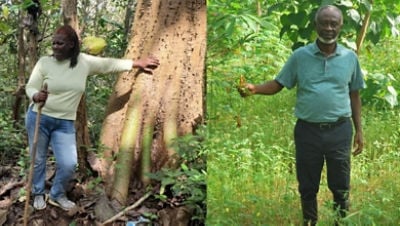
Ghana’s rich forests, vital to its economy and communities, face ongoing threats from unsustainable practices. However, a hopeful resurgence is emerging, driven by entrepreneurial initiatives that prioritize both economic development and ecological restoration. Individuals like Kwame Bonsu and Joann Ofori exemplify this movement, demonstrating how sustainable businesses can revitalize forest landscapes and empower local populations. Their stories highlight the transformative potential of aligning economic interests with environmental stewardship, providing a model for future forest-based development.
Kwame Bonsu, the founder of Sakam Savana, embarked on a mission to restore the Afram Headwaters Forest Reserve, recognizing the interconnectedness of forest health and community well-being. His vision involved not merely reforestation, but also creating economic opportunities for the communities reliant on the forest. Utilizing a loan from Ghana’s Forest Investment Program, supported by the Climate Investment Funds and the World Bank, Kwame expanded his plantation, creating over 180 jobs and enhancing food security in surrounding areas. He implemented agroforestry practices, integrating fruit trees with timber species, resulting in increased crop yields and profitability. This approach showcases the potential of sustainable forest management to simultaneously achieve ecological and economic gains.
Joann Ofori, the driving force behind Lordamn Farms Ltd., also benefited from the Forest Investment Program’s loan scheme. The funding enabled her to double her teak plantation’s size, creating employment and promoting environmental stewardship. By diversifying her crops with eggplant, maize, and okra, Joann secured short-term income while awaiting the maturity of her teak trees. This strategy demonstrates the viability of incorporating diverse income streams within a sustainable forestry model. Joann’s success also highlights the potential for women’s leadership in this traditionally male-dominated sector.
Ghana’s Forest Investment Program, implemented between 2015 and 2023, played a pivotal role in reducing deforestation and degradation. The program focused on strengthening policies, improving landscape management, empowering local communities, and promoting private sector engagement. The loan scheme, which benefited Kwame and Joann among nearly 100 small- and medium-sized enterprises, exemplified the program’s success in increasing financial access for sustainable forestry initiatives. The program’s broader impact extended to supporting cocoa farmers, diversifying community incomes, and improving the management of over 80,000 hectares of land, benefiting approximately 106,000 people in and around Ghana’s High Forest Zone.
The experiences of Kwame and Joann underscore the importance of people-centered approaches to forest management, showcasing how entrepreneurial innovation can be harnessed for both economic progress and ecological restoration. Their success stories also demonstrate the potential for forest enterprises to establish sustainable financial relationships with institutions, paving the way for long-term growth in the sector. The Forest Investment Program’s outcomes offer valuable lessons for future initiatives, highlighting the effectiveness of empowering local communities and engaging the private sector.
Building on the achievements of the Forest Investment Program, the World Bank’s Global Challenge Program: Forests for Development, Climate, and Biodiversity aims to scale up successful models and deepen investment in sustainable forestry. This framework seeks to replicate and expand upon successful interventions, such as facilitating financial access for forest enterprises, to create broader and more enduring impact. By supporting local innovation with global resources and expertise, the program aims to foster sustainable growth in Ghana’s forest sector, ensuring economic opportunities, environmental protection, and community well-being for future generations. The program’s emphasis on scaling successful models underscores the importance of learning from past experiences and adapting them to wider contexts. This approach promises to contribute significantly to the long-term viability of Ghana’s forest sector and its positive impact on the lives of millions who depend on it.
The successful implementation of the Forest Investment Program and the subsequent development of the Global Challenge Program highlight the evolving understanding of sustainable forest management. The shift from traditional conservation models to integrated approaches that prioritize both ecological integrity and economic development reflects a growing recognition of the interconnectedness between human well-being and environmental health. These initiatives demonstrate the potential for creating win-win scenarios where both forests and communities thrive, offering a promising pathway for sustainable development in Ghana and other forest-rich nations. By fostering entrepreneurship, empowering local communities, and leveraging innovative financing mechanisms, these programs are laying the groundwork for a future where forests play a central role in both economic prosperity and environmental resilience.