From Olympic Aspirations to Coaching Triumphs: The Journey of Anthony Konyagwachie
Anthony Konyagwachie’s boxing journey began in the wake of his brother’s Olympic silver medal win in 1984. Inspired by his brother’s achievement, Konyagwachie embarked on a self-taught boxing journey, meticulously mimicking his brother’s techniques and movements. Remarkably, within four years, he found himself competing on the Olympic stage, a testament to his natural talent and unwavering dedication. Coming from a family steeped in boxing tradition, Konyagwachie experienced no pressure to follow in their footsteps. His passion for the sport ignited organically, propelling him to international championship status just three years after his initial foray into the ring.
Konyagwachie’s illustrious boxing career spanned over a decade, from 1986 to 1997, earning him the distinction of being Nigeria’s most decorated international boxer. His impressive record boasts numerous accolades, including bronze medals from competitions in China and Germany in 1992, culminating in a coveted gold medal victory in Cuba in 1995. He consistently showcased his prowess on the global stage, participating in a multitude of international tournaments, leaving his mark from Nepal to Canada. Among his numerous achievements, Konyagwachie cherishes the gold medal victory in Cuba in 1995 as a defining moment in his career. He also fondly recalls his training experiences in Germany under the tutelage of a world champion coach. Even an unfortunate incident of being unjustly judged in a German fight couldn’t overshadow the positive memories of recognition and appreciation he received during that period.
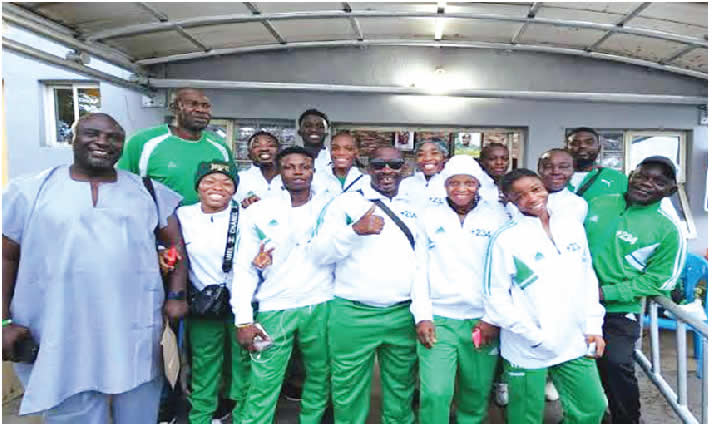
Konyagwachie’s transition from a decorated boxer to a national coach marked a new chapter in his boxing career. He transitioned from a boxer subjected to rigorous six to eight-month training camps to a coach navigating a significantly altered training landscape. The modern coaching environment presented new challenges, such as the compressed three-week training camp leading up to the African Games, a stark contrast to the extended camps he experienced as an athlete. To prepare his team for the African Games, Konyagwachie implemented an intensive training regimen, incorporating three daily training sessions, focusing on speed, endurance, and tactical development. This rigorous physical training was complemented by a spiritual dimension, with six daily prayer sessions, underscoring the coach’s belief in the synergy of physical and spiritual preparation. The outcome of this dedicated preparation, combined with a stroke of good fortune, led to a record-breaking performance.
Konyagwachie’s ambitious目標for the African Games was a minimum of 10 gold medals. His team delivered an exceptional performance, securing eight gold and two silver medals in the finals. This remarkable achievement solidified Konyagwachie’s reputation as a driven coach who consistently strives for excellence. He attributes his success not to any secret weapon, but to a combination of hard work, unwavering dedication, resolute determination, and the power of prayer. He emphasizes the importance of a favorable draw and meticulous preparation as key elements in achieving victory. His transparent coaching approach, with training sessions open to observation, underscores his belief in the power of shared knowledge and collaborative growth.
The African Games experience in Ghana presented both challenges and rewards. While the accommodation and late-night returns from the venue posed logistical difficulties, the provision of excellent meals and reliable transportation mitigated some of the hardships. Konyagwachie and his team remained unwavering in their focus, determined to overcome obstacles en route to their record-breaking goal. Konyagwachie’s deep-seated passion for nurturing his boxers stems from his personal experiences as a young athlete. His protective approach, bordering on fierce advocacy, reflects his commitment to shielding his athletes from the sometimes-harsh realities of the sporting world. He has tirelessly combated sentiments and political pressures to ensure deserving boxers receive their due opportunities, fiercely defending their place on the team.
His management of limited camp time relies on a strategic approach that leverages the continuous training of what he terms "program athletes." This strategy allows athletes to transition seamlessly into competition mode during short camp periods, optimizing their readiness. This approach proved particularly effective during the Commonwealth Games in Birmingham, where the team achieved success despite a mere two-week camp period. The selection process for the African Games involved a rigorous evaluation system to ensure the most deserving athletes represented the nation. This included a series of trials and competitive sparring sessions designed to identify the best boxers in each weight category. Konyagwachie notes the remarkable eagerness among the athletes to represent Nigeria. Their discipline and respect for the selection process facilitated smooth operations and a harmonious team environment.
Among the numerous impressive performances at the African Games, the triumph of super heavyweight boxer Ifeanyi Onyekwere particularly stood out for Konyagwachie. Onyekwere’s selection had been fraught with controversy, with attempts to exclude him from the camp. However, Konyagwachie, recognizing Onyekwere’s potential, steadfastly championed his inclusion, and the boxer ultimately delivered a stellar performance, vindicating his coach’s faith and demonstrating the coach’s keen eye for talent.