









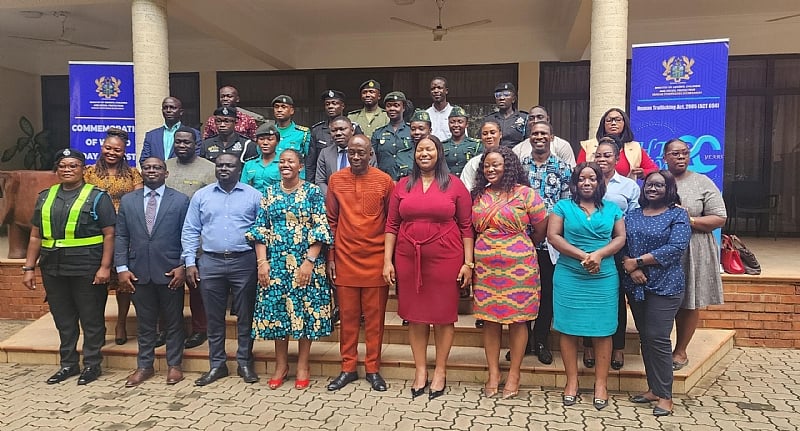
Human trafficking, a grave violation of human rights and a pervasive global crime, operates insidiously, often masked within seemingly legitimate activities and exploiting vulnerabilities born of poverty, conflict, and limited opportunities. The Ministry of Gender, Children and Social Protection in Ghana, recognizing the urgent need to combat this menace, has initiated a two-day intensive capacity-building workshop for law enforcement officers. This workshop serves as a critical platform to equip security personnel with the necessary knowledge and tools to effectively identify, investigate, and prosecute human trafficking offenses. The training focuses on enhancing understanding of the fundamental concepts of human trafficking, child labor, and the worst forms of child exploitation, while also drawing crucial distinctions between migrant smuggling and trafficking. Moreover, the program addresses evolving trends like the Q-Net scam and underscores the effective application of Ghana’s Human Trafficking Act.
The urgency of this initiative is underscored by the fact that human trafficking often goes unnoticed, even when occurring in plain sight, and is closely linked to irregular migration. Traffickers prey on vulnerable individuals, deceiving them with false promises of employment and a better life, only to ensnare them in exploitative situations. They leverage coercion and abuse of power to maintain control, trapping victims in cycles of exploitation that are difficult to break. Recognizing the multifaceted nature of this crime, the Ministry has prioritized capacity building as a crucial element in the fight against human trafficking and exploitation. This particular workshop is part of a larger effort that has already trained 1,750 law enforcement officers from various agencies including the Ghana Police Service, Ghana Immigration Service, the Economic and Organised Crime Office (EOCO), and the Customs Division of the Ghana Revenue Authority.
Recent successes in anti-trafficking operations highlight the effectiveness of collaborative efforts and the impact of well-trained personnel. The collaborative operation between the Ghana Police Service’s Anti-Human Trafficking Unit and Interpol, which resulted in the rescue of 66 Ghanaians trafficked to Nigeria under false pretences of employment opportunities, exemplifies the importance of international cooperation. These victims, lured with the promise of jobs in football and other sectors, were subjected to exploitative conditions for over a month before their rescue. Another significant victory came from EOCO’s arrest of 35 suspects and the rescue of over 219 trafficking victims, predominantly from Nigeria and other West African countries, who were being held against their will and forced into cybercrime and labor exploitation in a suburb of Accra. Furthermore, a joint operation involving Ghanaian and Ivorian authorities, supported by Interpol, led to the rescue of 33 West African victims from Abidjan, Côte d’Ivoire, who had been lured by deceptive job offers and subsequently coerced into fraudulent activities.
These successful operations not only underscore the importance of capacity building but also highlight the interconnectedness of trafficking networks and the need for cross-border collaboration. The victims, having paid exorbitant fees in anticipation of legitimate employment, were instead trapped in exploitative schemes, demonstrating the devastating financial and emotional toll of human trafficking. The collaborative nature of these successful operations emphasizes the need for a multi-agency approach to combat this pervasive crime, as no single entity can effectively address this complex issue alone. The Ministry stresses the importance of a collective effort involving government institutions, civil society organizations, community leaders, and international partners working in concert to protect vulnerable individuals and bring perpetrators to justice.
The Ghana Police Service, a vital partner in this fight, has reaffirmed its commitment to tackling human trafficking and recognizes the value of the Ministry’s training initiative. The training provides law enforcement officers with practical knowledge and tools needed to effectively combat trafficking, including the ability to recognize patterns and signs of exploitation, and to effectively apply Ghana’s Human Trafficking Act in prosecuting offenders. The participants themselves acknowledge the transformative impact of the workshop, describing it as an eye-opening experience that equips them with the skills and insights necessary to identify and respond effectively to trafficking cases. They appreciate the practical and enlightening nature of the sessions, emphasizing the need for similar training to be extended to more officers nationwide.
This capacity-building initiative is not merely a training program but a crucial step towards dismantling the intricate networks of human trafficking. By empowering law enforcement officers with the knowledge and tools to effectively identify, investigate, and prosecute these crimes, Ghana strengthens its commitment to protecting its citizens and those within its borders from this modern form of slavery. The continued collaboration between government agencies, international partners, and civil society is essential to maintaining momentum in this fight and ensuring that traffickers are held accountable for their actions. The shared goal is to create a society where vulnerable individuals are protected and the scourge of human trafficking is eradicated.









