





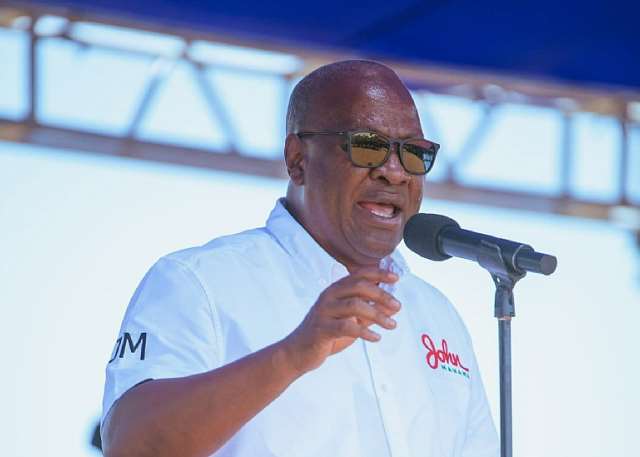
President-elect John Dramani Mahama has leveled accusations against the outgoing Akufo-Addo administration, alleging a deliberate attempt to sabotage the incoming government’s success. Addressing National Democratic Congress (NDC) supporters, Mahama criticized the current government’s fiscal management, citing a substantial debt burden as a major obstacle to the swift implementation of his administration’s policies. This hefty debt, according to Mahama, encompasses various sectors, including education and energy, painting a picture of a nation teetering on financial instability. He underscored the seriousness of the situation by highlighting the government’s outstanding payments to the West African Examinations Council (WAEC) and the Conference of Heads of Assisted Secondary Schools (CHASS), both crucial for the smooth functioning of Ghana’s education system. Furthermore, Mahama pointed to a staggering $2 billion debt in the energy sector, a figure that raises concerns about the future stability of the nation’s power supply.
Mahama’s remarks reflect a deep concern about the state of the nation’s finances and the potential impact on his administration’s ability to govern effectively. He characterized the situation as a “trap” set by the outgoing government, a deliberate attempt to undermine his ability to deliver on his promises to the Ghanaian people. This alleged sabotage, Mahama argued, is designed to create difficulties for his administration and portray him as incapable of managing the country’s affairs. This narrative, he suggested, is being fueled by members of the outgoing New Patriotic Party (NPP) who are predicting hardship and a return to the power crisis, locally known as “dumsor,” under his leadership.
Despite the daunting challenges ahead, Mahama projected an air of unwavering determination and confidence. He reassured his supporters of his commitment to fulfilling his campaign promises and expressed unwavering faith in his ability to lead Ghana to prosperity. He invoked divine intervention, attributing his electoral victory to God’s will and expressing confidence that the same divine power would guide him through the complex challenges inherited from the previous administration. This reliance on faith, Mahama indicated, is a source of strength and resilience, enabling him to navigate the treacherous financial landscape and steer the nation towards a brighter future.
Mahama’s address served as both a critique of the outgoing government and a declaration of his own resolve. He framed the inherited debt as a deliberate attempt to sabotage his administration, a challenge he vowed to overcome with divine guidance and astute leadership. His message resonated with his supporters, offering them reassurance in the face of potential economic hardship. By emphasizing his faith and determination, Mahama sought to project an image of a leader capable of navigating complex challenges and delivering on his promises, despite the obstacles placed in his path.
The President-elect further elaborated on the specific debts, drawing attention to the unprecedented situation of WAEC potentially withholding examination results due to non-payment. He used this example to illustrate the severity of the financial mismanagement he attributed to the Akufo-Addo government, highlighting the potential impact on students and the disruption it could cause to the education system. Similarly, he pointed to the outstanding payments to CHASS, emphasizing the strain on secondary schools and the potential implications for the quality of education provided to Ghanaian children. These specific examples served to personalize the debt crisis, moving beyond abstract figures to demonstrate the real-world consequences of the alleged financial mismanagement.
Mahama’s speech concluded with a powerful declaration of faith and a renewed commitment to serving the Ghanaian people. He expressed his belief that God had “already done it,” signifying his confidence in overcoming the challenges ahead. He called for increased prayer, not for electoral victory, but for the wisdom and strength to implement policies that would uplift Ghana. This call to prayer served as a unifying message, bringing together his supporters in a shared belief in divine intervention and the promise of a better future. This concluding message emphasized his commitment to the nation’s well-being, portraying him as a leader driven by faith and a desire to serve the next generation.








