









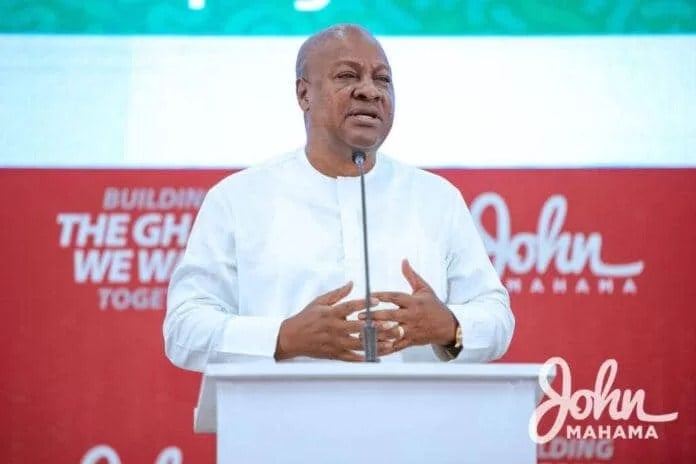
John Dramani Mahama, Ghana’s President-elect, addressed concerns regarding the National Democratic Congress’s (NDC) substantial parliamentary majority achieved in the December 7th elections. Speaking at a New Year’s Eve church service, Mahama underscored the importance of collaborative governance, rejecting the notion that the NDC’s majority grants them unchecked authority. He emphasized that nation-building is a collective endeavor, requiring the participation of all citizens, regardless of political affiliation. This message of inclusivity aimed to reassure the public that the NDC’s legislative advantage wouldn’t translate into exclusionary practices and sought to foster an environment of unity and cooperation in the upcoming presidential term.
Mahama’s victory, securing 56.55% of the vote, signifies a return to the presidency for him, beginning on January 7, 2025. While the NDC’s significant parliamentary majority undeniably strengthens their position, Mahama’s focus on collaborative governance signals a commitment to engaging with other political parties. This approach is crucial for ensuring political stability and facilitating the smooth implementation of policies. By acknowledging the limitations of unilateral action, Mahama aims to build consensus and create a more inclusive political landscape. This conciliatory tone sets the stage for potential cross-party collaboration on key national issues in the coming years.
The President-elect stressed that the significant parliamentary majority is not a license for the NDC to govern unilaterally but rather an opportunity to work collaboratively with other political factions to achieve national development goals. He reiterated that the success of his administration hinges on the collective effort of all Ghanaians. He specifically named various political parties, including the opposition New Patriotic Party (NPP), the Convention People’s Party (CPP), the People’s National Convention (PNC), and smaller parties, inviting them to participate in the nation-building process. This inclusive approach demonstrates Mahama’s commitment to bridging political divides and fostering a sense of shared responsibility for the nation’s future.
Mahama’s call for unity signifies a departure from the often-polarized nature of Ghanaian politics. He acknowledged that while he was the face on the ballot paper, representing the NDC, the task of building a prosperous Ghana requires a collective effort transcending party lines. He emphasized that no single individual or party possesses all the answers, and therefore, inclusive dialogue and cooperation are essential for progress. This inclusive rhetoric aims to build trust and promote a sense of national unity, crucial for tackling the complex challenges facing the nation.
The President-elect’s emphasis on “togetherness” highlights the importance of collective action in addressing the diverse needs and aspirations of the Ghanaian people. He acknowledged that his victory represents a mandate from the people but also carries the responsibility of representing all Ghanaians, not just those who voted for him. He underscored the importance of fostering a political environment where diverse voices are heard and considered, paving the way for more equitable and effective policymaking. This inclusive approach aims to build a more united and prosperous Ghana, reflecting the collective aspirations of its citizens.
By emphasizing the concept of “building the Ghana we want together,” Mahama seeks to establish a shared vision for the nation’s future, one that transcends partisan divides and focuses on the common good. He implicitly recognizes that sustainable development and progress require the active participation and contribution of all stakeholders, irrespective of their political affiliations. This commitment to inclusivity and collaboration signals a positive step towards a more unified and prosperous Ghana, ready to tackle the challenges and opportunities that lie ahead. His call for unity and collaboration sets the tone for his upcoming presidency, emphasizing the shared responsibility of all Ghanaians in building the nation’s future.









