









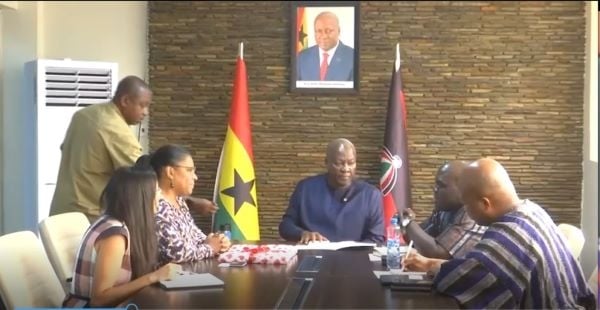
The incoming Mahama administration is establishing an “Operation Recover All Loot” (ORAL) committee, sparking concerns about potential political witch-hunting. President-elect Mahama has directly addressed these anxieties, emphasizing that the committee’s function is not to persecute individuals but to serve as a central hub for collecting evidence of corruption and misconduct. This evidence will then be passed on to the appropriate investigative bodies within the government for proper due process. Mahama underscores that ORAL is not an investigative body itself, but rather a mechanism for systematically receiving and organizing information regarding alleged corrupt activities. The concerns stem from the transition of power, with the outgoing Akufo-Addo administration likely wary of politically motivated investigations. Mahama’s assurances aim to allay these fears, framing ORAL as a tool for transparency and accountability, not a weapon for retribution.
The central purpose of the ORAL committee, as outlined by Mahama, is to create a streamlined process for handling allegations of corruption. Recognizing the potential for a deluge of information, often fragmented and unverified, the committee aims to provide a single point of contact for individuals and organizations to submit evidence. This centralized approach is intended to enhance efficiency and ensure that all credible allegations receive proper attention. Rather than conducting investigations, ORAL will collate and categorize information, preparing it for submission to existing government agencies equipped to conduct thorough investigations. This structured approach emphasizes the importance of due process and reinforces the idea that ORAL is not a parallel investigative structure operating outside established legal frameworks.
Mahama’s assurance that ORAL is not a “witch-hunting committee” is a direct response to the political sensitivities surrounding the transition of power. Transitions often bring scrutiny of the previous administration’s actions, and the establishment of a committee explicitly focused on corruption can easily be interpreted as politically motivated. By emphasizing that ORAL will not conduct investigations but merely collect and organize information, Mahama seeks to differentiate it from a targeted effort to prosecute political opponents. The reassurance aims to build trust and demonstrate a commitment to fair and impartial governance, addressing concerns about selective justice or politically motivated prosecutions.
The operational structure of the ORAL committee further underscores its intended function as an information-gathering body. Mahama highlights that the committee is operating on a pro bono basis, with no dedicated budget or allocated resources. This reinforces the idea that ORAL is not a large-scale investigative enterprise, but rather a focused effort to centralize information gathering. The absence of financial backing suggests a limited scope and emphasizes reliance on existing government agencies for the actual investigative work. This lean structure supports Mahama’s claim that ORAL is not a tool for political maneuvering but a practical mechanism for enhancing transparency and accountability.
The call for collaboration between political parties and civil society organizations reflects a broader commitment to fostering a culture of transparency and accountability. Mahama’s emphasis on inclusivity aims to demonstrate a genuine desire to address corruption as a systemic issue, rather than a partisan tool. By inviting participation from across the political spectrum, he seeks to build consensus around the importance of tackling corruption and to establish ORAL as a neutral platform for pursuing this goal. This collaborative approach signifies a departure from potentially divisive tactics and suggests a sincere intention to create a more transparent and accountable government.
In conclusion, the establishment of the ORAL committee represents a complex maneuver in the context of a political transition. While concerns about potential political witch-hunting are understandable, Mahama’s explanation and the operational structure of the committee suggest a more nuanced approach. By emphasizing its role as an information-gathering body, its reliance on existing investigative agencies, and its commitment to transparency and collaboration, Mahama aims to position ORAL as a tool for promoting good governance rather than a weapon for political retribution. The success of this initiative will depend on the public’s perception of its impartiality and its ability to genuinely contribute to a more transparent and accountable political environment. The ultimate test will be whether the evidence gathered by ORAL leads to credible investigations and tangible outcomes, demonstrating its commitment to addressing corruption regardless of political affiliation.









