









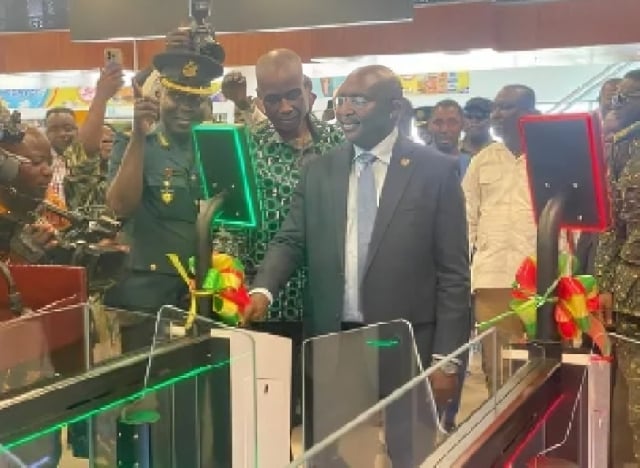
Former President John Mahama recently addressed the e-gate malfunction involving Vice President Dr. Mahamudu Bawumia at Kotoka International Airport (KIA), criticizing the incident as a clear reflection of the current government’s failures in the realm of digitalisation. During a community event in Esaase Bontefufuo, Ashanti Region, on December 4, 2024, Mahama jested about the malfunction, saying, “The digital gate didn’t open for the digital man.” This statement was met with laughter and applause from attendees, illustrating the effectiveness of his comedic approach to delivering a political critique.
The incident in question unfolded just a day after Dr. Bawumia had ceremoniously inaugurated the e-gates at KIA, which he touted as a significant milestone in his administration’s push for digital innovation. However, the situation took an embarrassing turn when the e-gate malfunctioned while the Vice President was trying to use it. Mahama seized this opportunity to mock Bawumia’s grand presentation, implying that the fanfare surrounding the e-gates was unwarranted since they are commonplace in airports globally. His remarks suggested that the excessive celebration over the achievement was misplaced, given that the underlying technology failed to perform when needed.
In his commentary, Mahama expressed skepticism about the government’s digitalisation agenda, stating, “You can do all the propaganda you want, but if the fundamentals of your digitalisation are weak, the e-gate will expose you.” This pointed observation was a nod to Bawumia’s own previous comments regarding the importance of economic fundamentals—a clear way of holding the Vice President accountable for the disconnect between claims of progress and actual performance. Mahama’s critique signals a broader concern over the quality and reliability of the government’s digital initiatives, suggesting a gap between the administration’s rhetoric and reality.
Moreover, Mahama emphasized that citizens should focus on competence and substantive development as they approach the upcoming elections. He insinuated that under the current administration, optics have taken precedence over genuine advancements, urging voters to be discerning when evaluating the achievements of their leaders. By spotlighting this incident, he aims to reinforce the notion that true progress should not merely be about appearances but rather robust and functional systems that serve the public effectively.
The political ramifications of the e-gate incident extend beyond mere mockery; they serve as a critique of the broader digital transformation strategy implemented by Bawumia and the government. Mahama is positioning himself as a voice of reason, calling for a reassessment of the competence required for leadership in a technology-driven world. He is effectively leveraging the situation to galvanize support for his party, the National Democratic Congress (NDC), by advocating for a shift away from superficial achievements towards more significant, lasting improvements in public services.
In conclusion, Mahama’s comments regarding the e-gate incident encapsulate his strategy of addressing the vulnerabilities of the current administration through wit and critical analysis. He juxtaposes the embarrassment of the Vice President with a call to action for voters to reassess their priorities and demand accountability from their leaders. By framing the incident as representative of larger systemic issues within the government’s digitalisation efforts, Mahama hopes to resonate with constituents who value practicality and reliability in governance as the election approaches.









