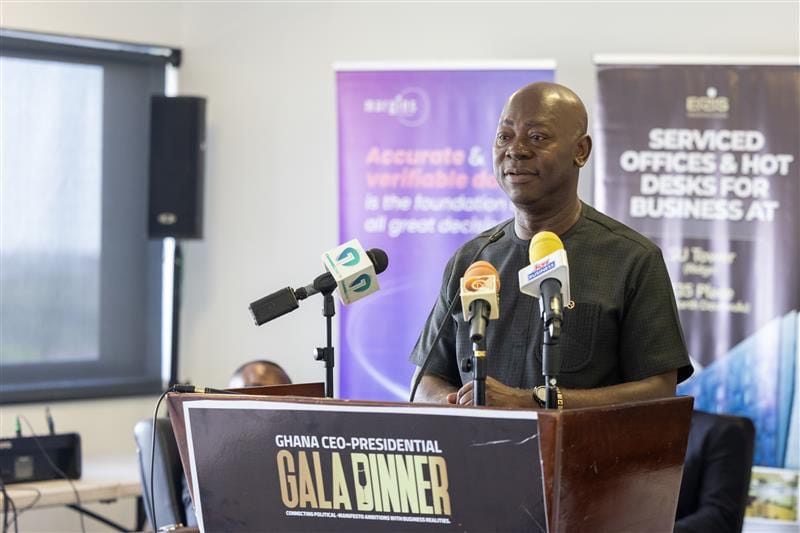
The Chief Executive Officer (CEO) of Margins ID Group, Mr. Moses Kwesi Baiden Jnr, addressed the critical role of business leaders in shaping policies that foster economic growth and political transparency during the launch of the “1st Ghana CEO-Presidential Manifesto Gala Dinner” in Accra. He underscored that Ghana’s desired future will not materialize by mere chance but through proactive engagement and demands for accountability from both business leaders and government officials. Mr. Baiden portrayed the Gala as a significant event, highlighting its potential as a platform for collaboration between the business sector and political leadership aimed at enhancing Ghana’s socio-economic landscape.
At the Gala Dinner, Mr. Baiden characterized the event as a defining moment for both business and politics, labeling it a ‘beacon of progress’ where voices of business leaders could resonate with those in positions of power. He articulated that this unique opportunity could facilitate direct engagement with political leaders, encouraging them to create a conducive environment where businesses can grow alongside effective governance. Stressing the significance of such interactions, he called for a partnership that would encourage innovation, accountability, and broad-based economic progress—essentially setting a new agenda for Ghana’s future where political manifestos are closely intertwined with actionable plans from the business community.
In further discussions, Mr. Baiden outlined several strategic recommendations critical for sustainable growth in Ghana. He remarked on the nation’s rich potential, citing resources like gold, oil, and cocoa, alongside its human capital and entrepreneurial spirit. He advocated for a governance framework that harnesses this potential through systemic changes that eliminate barriers to business growth. His recommendations included the establishment of a Permanent Business Advisory Council focused on policy reform, a comprehensive overhaul of regulatory frameworks, boosting the digital economy, and fostering an environment rooted in evidence-based policymaking—all vital components that would empower Ghanaian businesses to thrive in global markets.
The Gala functioned not only as an event but also as a movement aimed at fostering accountability and political collaboration to ignite economic growth. Baiden emphasized the importance of the commitments derived from this gathering, including the Social Contract Signing and the promotion of Public-Private Partnerships (PPPs). These commitments are believed to be essential in the creation of a favorable environment for businesses, thus securing a prosperous future for Ghana. In his message, Mr. Baiden urged industry leaders to embrace their roles, take ownership of the dialogue, and leverage the platform to ensure a sustained push for development.
Echoing Mr. Baiden’s sentiments, Ernest De-Graft Egyir, Founding CEO of Chief Executives Network Ghana, noted the untapped economic potential of Ghana amid existing challenges like economic instability and political transparency. He highlighted a significant aspect of the Gala would be the signing of a social contract by political flagbearers from the National Democratic Congress (NDC) and the New Patriotic Party (NPP). This pact would underline their commitment to good governance and collaborative economic strategies, an initiative aimed at reinforcing hope in the business community and accountability in the political arena.
In addition, George Ankomah, Lead Tax Partner of Deloitte, accentuated the necessity for harmonized efforts between the business sector and political leaders for sustainable growth in Ghana. He noted that while political manifestos offer theoretical visions for the country’s future, the real pathway to prosperity lies in actionable, collaborative efforts. The Gala, organized by the Chief Executives Network Ghana in partnership with several prominent institutions, was aimed at providing opportunities for CEOs and political leaders to align their strategies for long-term economic growth and social responsibility well beyond the year 2025. This collective approach is seen as paramount in addressing current economic challenges and ensuring a thriving future for Ghana.