









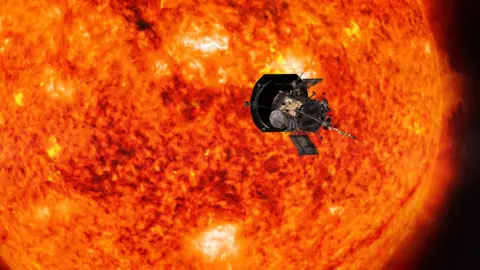
The Parker Solar Probe, a NASA spacecraft, accomplished a groundbreaking feat by surviving the closest-ever approach to the Sun, marking a significant milestone in solar exploration. After a period of radio silence during its perilous flyby, the probe re-established contact with Earth, sending a signal shortly before midnight EST on Thursday, December 27th, 2024 (05:00 GMT on Friday, December 28th, 2024), bringing immense relief to the anxiously awaiting scientists at NASA. The probe was confirmed to be operational and functioning normally, a testament to its robust design and engineering. This daring maneuver involved the probe plunging into the Sun’s outer atmosphere, known as the corona, on Christmas Eve, enduring scorching temperatures of up to 1,800°F (980°C) and extreme radiation levels.
The primary objective of this close encounter was to gather crucial data that will enhance our understanding of the Sun’s dynamics and behavior. Scientists aim to unravel the mysteries surrounding the extreme heating of the corona, which reaches millions of degrees Celsius despite being further away from the Sun’s surface, which is around 6,000°C. The probe’s measurements will shed light on the mechanisms that heat this region to such extraordinary temperatures. Additionally, the mission seeks to pinpoint the origin of the solar wind, a continuous stream of particles emanating from the Sun, and to decipher how energetic particles are accelerated to near-light speed. By venturing directly into the Sun’s atmosphere, the Parker Solar Probe offers an unprecedented opportunity to obtain firsthand information about the Sun’s environment, a feat impossible through remote observation alone.
The Parker Solar Probe, launched in 2018, has been steadily approaching the Sun over a series of 21 progressively closer flybys. The Christmas Eve flyby set a new record, bringing the probe within a mere 3.8 million miles (6.1 million km) of the solar surface. While this might still seem like a considerable distance, it represents an incredibly close approach in astronomical terms. To put this in perspective, if the Earth and Sun were placed one meter apart, the Parker Solar Probe would be just 4cm from the Sun, highlighting the extreme proximity of the spacecraft to our star. This daring maneuver exposed the probe to intense heat and radiation, requiring meticulous planning and robust protective measures to ensure its survival.
To withstand the extreme conditions near the Sun, the Parker Solar Probe is equipped with a 4.5-inch thick carbon-composite heat shield that protects its sensitive instruments from the intense heat and radiation. Even with this shield, the spacecraft still experienced temperatures of 1,400°C, demonstrating the extreme environment it encountered. The probe’s strategy involved a rapid in-and-out maneuver, minimizing its exposure to the harsh conditions. During its closest approach, the Parker Solar Probe reached an astounding speed of 430,000 mph (692,000 kph), making it the fastest human-made object ever. This incredible velocity was a result of the immense gravitational pull exerted by the Sun as the probe approached.
The Parker Solar Probe’s mission is driven by a desire to understand fundamental processes occurring within the Sun’s atmosphere. One of the most significant puzzles is the extraordinary temperature of the corona, which reaches millions of degrees Celsius despite being further from the Sun’s surface than the photosphere, which is around 6,000°C. Scientists hope that the data collected by the probe will finally provide an explanation for this counterintuitive phenomenon. Additionally, the mission aims to provide a deeper understanding of the solar wind, the continuous stream of charged particles emanating from the corona. These particles influence space weather, which can impact Earth’s magnetic field, satellite communications, and even power grids.
The successful completion of the close flyby and the subsequent re-establishment of communication marked a momentous occasion for the NASA team. The probe’s survival and the collection of valuable data are a testament to the ingenuity and dedication of the scientists and engineers involved in the mission. The Parker Solar Probe’s continued journey towards the Sun promises to unveil further secrets about our star, furthering our understanding of the solar system and the complex interactions between the Sun and Earth. The data gathered by the probe will not only advance scientific knowledge but also provide insights into space weather, enabling better predictions and mitigation strategies to protect our technological infrastructure from solar storms.









