





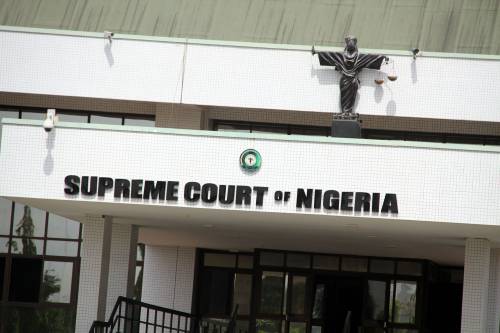
Nasarawa and Ogun States have taken legal action against the Nigerian Financial Intelligence Unit (NFIU) regarding its newly established cash withdrawal limits. Both states, alongside 17 others, are challenging aspects of the Economic and Financial Crimes Commission (EFCC) in a broader case before the Supreme Court, scheduled for hearing on October 22. While the suit largely focuses on the constitutionality of the EFCC’s establishment, Nasarawa and Ogun are specifically contesting the NFIU’s guidelines issued on January 3, 2023, which imposes cash withdrawal ceilings of N5 million for individuals and N10 million for corporate entities from state and local government accounts. The states express concerns that these limitations will significantly hinder their financial autonomy and ability to govern effectively, as failure to comply can result in severe penalties, including imprisonment.
The guidelines issued by the NFIU not only constrain state and local governments from making substantial cash withdrawals but also carry legal ramifications for non-compliance, which the agency threatens can lead to jail terms of up to three years. Nasarawa State’s Attorney General, Magaji Labaran, argues in his suit that the guidelines violate constitutional provisions granting state governments exclusive control over their finances. He contends that this financial restriction limits the ability of the Nasarawa State government and its local councils to fulfill their obligations related to the provision of essential services, thus disrupting governance and implementation of the state’s annual budget.
In his argument, Labaran emphasizes that establishing the EFCC itself was unconstitutional as it did not receive the necessary concurrence from state legislatures, including that of Nasarawa State, as mandated by the constitution. Despite this perceived illegitimacy, the EFCC has been consistently enforcing its mandates against officials in Nasarawa. The state argues that the authority to prosecute under the EFCC’s purview should not extend to matters involving the management of state funds without explicit constitutional backing. Additionally, Labaran seeks a declaration that federal agencies such as the NFIU overstep their jurisdictions when it comes to the regulation of state financial matters.
In contrast, Ogun State has clarified its position regarding the EFCC and NFIU’s guidelines. In a statement issued by the gubernatorial media adviser, it noted that prior legal determinations by the Supreme Court have upheld the constitutionality of the EFCC and related laws. Ogun State emphasizes that it is not engaging in a broader constitutional debate over the EFCC’s establishment but rather contests the specific NFIU guidelines that limit cash withdrawals, arguing these limits disrupt state governance and conflict with local financial management needs. The state seeks relief from the Supreme Court to ensure it can administer its budgetary processes without undue federal interference.
Ogun State cites recent judicial victories against federal policies that negatively impacted state governance, referencing their success against the naira redesign policy imposed by the Central Bank of Nigeria. The state insists that the NFIU’s cash withdrawal guidelines function similarly as oppressive regulations, restricting local governments’ access to their already allocated funds. By highlighting this legal and governance disruption, Ogun State aims to invalidate the NFIU’s cash withdrawal restrictions, allowing for the unencumbered use of state resources.
In summary, the legal challenges posed by Nasarawa and Ogun States against the NFIU’s cash withdrawal limits reflect broader concerns about state autonomy in financial matters. While both states engage in a legal struggle over the restrictions imposed by the NFIU, they each focus on different aspects of the law concerning governance and financial management. The outcome of the Supreme Court hearings scheduled for October 22 could determine the extent to which federal directives can encroach upon state financial autonomy, potentially reshaping how states manage their finances in Nigeria. These developments underscore the ongoing tension within Nigeria’s federal structure regarding the balance of power between state and federal authorities, especially in matters related to financial governance.








