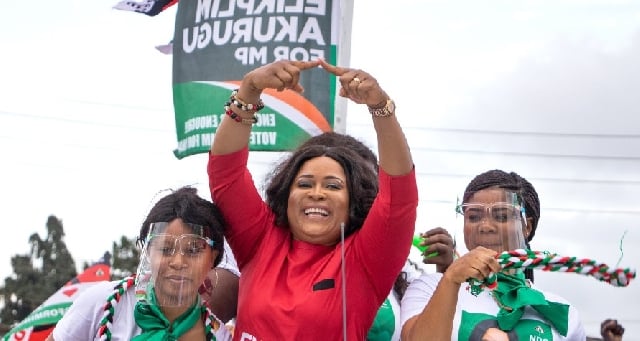
The Dome-Kwabenya constituency, a pivotal electoral battleground in Ghana’s political landscape, witnessed a dramatic showdown between the National Democratic Congress (NDC) and the New Patriotic Party (NPP) during the December 7 elections. Faustina Elikplim Akurugu, the NDC’s parliamentary candidate, publicly challenged her NPP counterpart, Mike Oquaye, amidst a contentious vote-counting process. As allegations of premature victory declarations and voter intimidation swirled, the legitimacy of the election results hung in the balance, underscoring the deep political divisions and the high stakes of this particular race. Ms. Akurugu’s audacious challenge to Mr. Oquaye to present himself at the collation center reflected the escalating tensions and the NDC’s determination to ensure a transparent and accurate count.
The heart of the dispute lies in the NPP’s assertion of victory for Mr. Oquaye before the official collation of results was completed. Ms. Akurugu vehemently contested this claim, accusing the NPP of attempting to preemptively declare a winner in a race that was still too close to call. She further dismissed Mr. Oquaye’s campaign as relying heavily on the legacy and influence of his father, a prominent figure in Ghanaian politics. This accusation highlighted the complex interplay of familial ties and political power within the constituency, suggesting that Mr. Oquaye’s perceived advantage stemmed not solely from his own merits but also from the established political capital of his family. The ongoing collation process, Ms. Akurugu emphasized, was the only legitimate means of determining the true victor, and any premature declarations were attempts to undermine the democratic process.
Adding fuel to the fire were accusations leveled against the NDC of deploying “land guards,” private security personnel often associated with intimidation tactics, to the collation center. These allegations raised concerns about the safety and freedom of NPP supporters and agents to participate in the electoral process. Ms. Akurugu categorically denied these claims, asserting that the individuals present were simply party supporters exercising their right to observe the proceedings. This clash of narratives further underscored the deep mistrust between the two parties and the potential for misinformation to exacerbate an already tense situation. The presence of individuals perceived as security threats, regardless of their actual affiliation, inevitably cast a shadow over the integrity of the collation process and fueled anxieties about potential interference.
The Dome-Kwabenya constituency has emerged as a key battleground in Ghana’s electoral landscape, and the contested outcome reflects the broader political dynamics at play. The closely watched race has become a microcosm of the national political scene, where power struggles and partisan divisions are deeply entrenched. The accusations and counter-accusations exchanged between the NDC and NPP highlight the high stakes involved and the intense competition for political dominance. The outcome of this particular race carries significant implications for both parties, influencing not only the local representation but also the overall balance of power in the national political arena.
The controversy surrounding the Dome-Kwabenya parliamentary election underscores the critical importance of transparency and integrity in electoral processes. The allegations of premature victory declarations, voter intimidation, and the deployment of private security personnel raise serious questions about the fairness and credibility of the election. These issues, if left unaddressed, can erode public trust in democratic institutions and create an environment conducive to political instability. Ensuring a transparent and accountable vote-counting process is paramount to upholding the principles of democracy and maintaining the legitimacy of the elected government.
The events unfolding in Dome-Kwabenya serve as a stark reminder of the challenges faced by emerging democracies in consolidating their democratic gains. The intense political competition, coupled with allegations of electoral malpractice, can undermine the foundations of democratic governance. A robust and impartial electoral system, capable of investigating and addressing such allegations effectively, is crucial for safeguarding the integrity of the democratic process. The outcome of the Dome-Kwabenya election will undoubtedly have far-reaching consequences, not only for the constituency itself but also for the broader political landscape of Ghana. It remains to be seen how these events will shape the future of political discourse and the ongoing struggle for a more transparent and accountable democratic system.