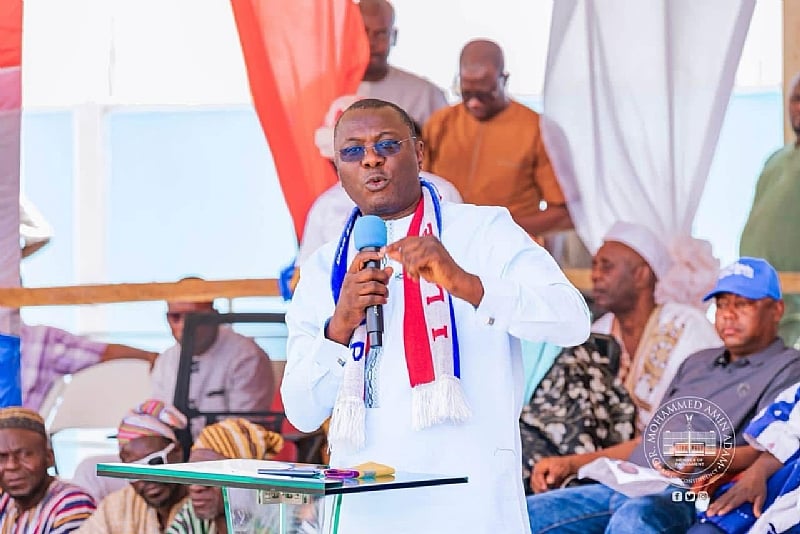
The political landscape of Ghana has witnessed a contentious debate surrounding the recent introduction of a GH¢1 fuel levy by the National Democratic Congress (NDC) government. Former Finance Minister and Salaga MP, Dr. Mohammed Amin Adam, has vehemently criticized the levy, accusing the NDC of employing deceptive tactics by initially scrapping certain taxes, only to reintroduce them indirectly through this new fuel levy. He argues that the removal of taxes such as the e-levy, betting tax, and emission levy served as a smokescreen, masking the government’s true intention of generating even greater revenue from petroleum products. This move, according to Dr. Adam, effectively negates the purported benefits of the earlier tax cuts and further burdens the Ghanaian populace. He contends that the GH¢1 levy, projected to generate GH¢5.7 billion, surpasses the combined revenue generated by all the scrapped taxes, thereby exacerbating the financial strain on citizens.
Dr. Adam’s critique centers on the government’s perceived inconsistency and lack of transparency in its fiscal policies. He highlights the disparity between the government’s celebratory pronouncements regarding the abolition of “nuisance taxes” and the subsequent imposition of a substantial fuel levy. This, he suggests, exposes the government’s true motive, which is not to alleviate the economic burden on Ghanaians, but rather to bolster its own revenue streams. Dr. Adam’s argument rests on the premise that the newly introduced levy will ultimately extract more money from the pockets of citizens than the repealed taxes would have, thus negating any purported benefits of the earlier tax cuts. This, in turn, raises concerns about the government’s commitment to genuine tax relief and casts doubt on its stated intentions of easing economic pressures.
The NDC government, led by President Mahama, had justified the repeal of the earlier taxes as a measure to alleviate the economic hardships faced by Ghanaians, attributing these hardships to the previous New Patriotic Party (NPP) administration. Finance Minister Dr. Cassiel Ato Forson presented the tax cuts as a crucial step towards providing much-needed relief to the populace. However, Dr. Adam’s accusations challenge this narrative, suggesting that the tax cuts were merely a political maneuver designed to create a positive image for the NDC government while simultaneously laying the groundwork for the introduction of the more lucrative fuel levy. This raises questions about the government’s sincerity in addressing the economic concerns of its citizens and underscores the political undercurrents influencing these fiscal decisions.
The controversy surrounding the fuel levy underscores the complex interplay between economic policy and political strategy. Dr. Adam’s accusations paint a picture of a government prioritizing its own revenue needs over the well-being of its citizens. By presenting the earlier tax cuts as a form of relief, the government, according to Dr. Adam, effectively manipulated public perception and secured political capital, only to subsequently impose a more substantial financial burden through the fuel levy. This raises concerns about the government’s transparency and accountability in its fiscal dealings. The significant difference between the projected revenue from the fuel levy and the combined revenue from the repealed taxes further fuels Dr. Adam’s argument, suggesting a deliberate attempt to maximize government revenue at the expense of the Ghanaian people.
The introduction of the GH¢1 fuel levy has sparked a heated debate about the government’s economic priorities and its commitment to alleviating the financial burdens on its citizens. Dr. Adam’s accusations of deception and manipulation highlight the potential for political maneuvering within fiscal policy decisions. The government’s justification for the levy, while framed as a necessary measure, appears to contradict its earlier actions of repealing taxes purportedly aimed at easing economic pressures. This apparent contradiction raises questions about the government’s true motivations and its commitment to transparent and equitable economic policies.
The unfolding situation in Ghana serves as a reminder of the intricate relationship between economic policy and political strategy. The controversy surrounding the fuel levy underscores the importance of scrutinizing government actions and holding them accountable for their decisions. Dr. Adam’s critique serves as a call for greater transparency and a more genuine commitment to alleviating the economic burdens faced by the Ghanaian people. The debate surrounding the levy is likely to continue as citizens grapple with the implications of this new tax and its potential impact on their livelihoods.