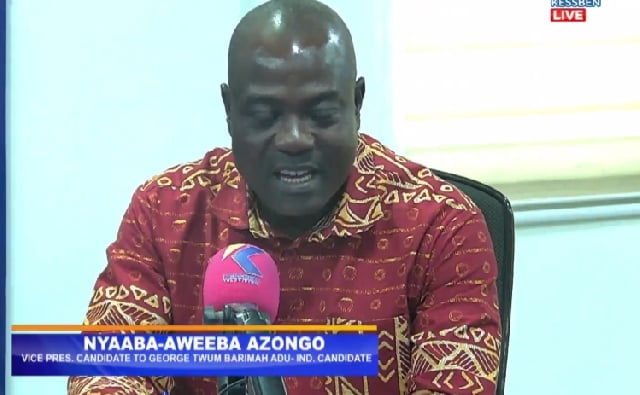
Nyaaba Aweeba Azongo, running mate to independent Presidential Candidate George Twum Barimah-Adu, has taken a critical stance against Ghana’s two dominant political parties—the New Patriotic Party (NPP) and the National Democratic Congress (NDC). In his view, these parties have been responsible for the country’s developmental challenges since the establishment of the 1992 Constitution. Azongo argues that rather than achieving genuine progress, both parties have led the nation into a cycle of economic crises characterized by significant inequality and hardship. He points out that the governance switch between the NPP and NDC has resulted in unfavorable economic conditions that have largely benefited a small elite at the expense of the majority of Ghanaians.
Azongo highlights that the repeated reliance on the International Monetary Fund (IMF) for financial bailouts is indicative of a failed economy that has been mismanaged by both the NPP and NDC. He suggests that instead of fostering growth and development, these parties have instead entrenched a system that perpetuates economic dependency and crisis. According to him, the political strategies employed by both parties have not only exacerbated poverty but have also deepened economic inequality, resulting in a society polarized between the affluent and the impoverished. This situation, he contends, reflects a significant betrayal of the citizens’ trust by the political leadership.
With Ghana’s elections approaching on December 7, Azongo calls for a decisive break from the traditional two-party system. He believes that electing George Twum Barimah-Adu represents a chance for the country to exit the cycles of despair brought about by the NPP and NDC. He emphasizes the importance of introducing a new political vision that prioritizes the welfare of all Ghanaians over that of a select few. Azongo asserts that real change in Ghana’s socio-economic landscape is necessary, and this requires a leadership that understands the need for inclusive growth and a redistribution of resources.
Moreover, Azongo argues for a restructuring of the country’s economic policies to ensure that opportunities are available to all citizens, irrespective of their socioeconomic background. He advocates for an economic model that focuses on lifting everyone out of poverty rather than benefiting particular interests. In his perspective, a fundamental shift in governance is crucial for Ghana to achieve true development, which necessitates innovative thinking and a dedication to equity. His vision for the country entails embarking on new paths for economic management and community development that can address the root causes of inequality.
During an interview on Accra-based Kessben FM, Azongo reinforced the urgency of his message and the need for Ghana to rethink its political choices. He concluded by urging citizens to consider the profound implications of their votes during the upcoming election—namely, the opportunity to choose a path toward a more equitable and prosperous future. This appeal for change is not just a political strategy but a heartfelt call for a national renewal that seeks to transform the lives of Ghanaians across the spectrum. Azongo’s firm belief is that with the right leadership and vision, Ghana can break free from the shackles of past failures and emerge stronger and more unified.
In summary, Nyaaba Aweeba Azongo’s critique of Ghana’s major political parties sheds light on the persistent economic challenges faced by the nation. His call for a new approach to governance highlights the importance of inclusivity and economic equality. As the elections near, his advocacy for change represents a significant rallying cry for citizens seeking a departure from traditional party politics that have failed to deliver genuine development and progress. By championing the candidacy of George Twum Barimah-Adu, Azongo hopes to inspire a political shift that prioritizes the collective wellbeing of all Ghanaians, fostering a more equitable and sustainable future for the country.