









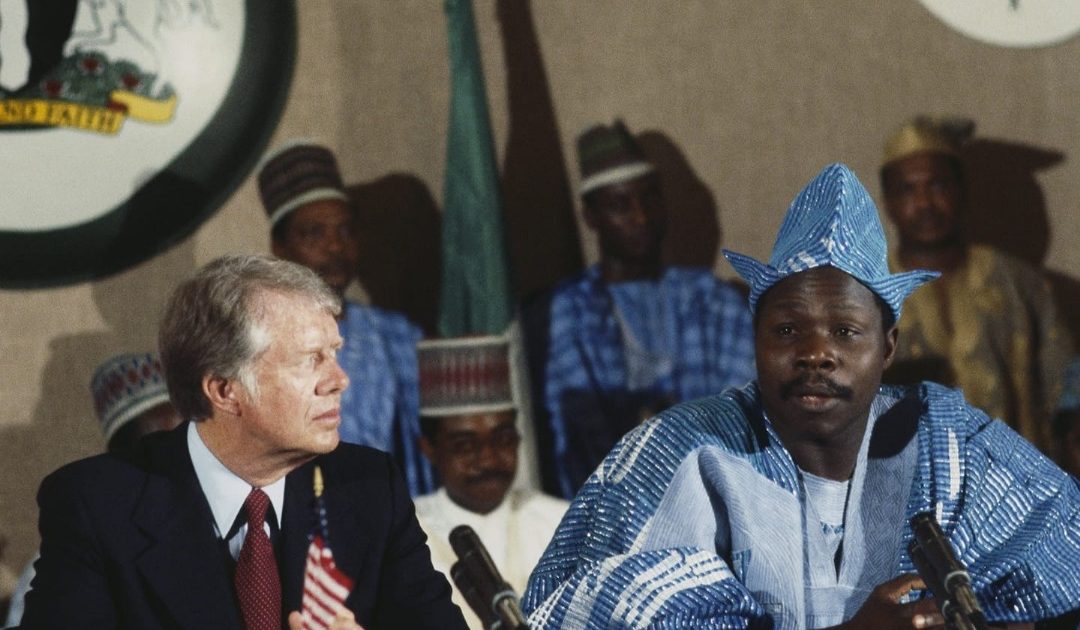
Jimmy Carter, the 39th President of the United States, left an indelible mark on the world stage, not just through his political career, but also through his unwavering commitment to human rights and humanitarian efforts. His legacy extends far beyond American borders, touching the lives of individuals and nations across the globe. One such individual deeply impacted by Carter’s compassion and courage was former Nigerian President Olusegun Obasanjo, who, during a memorial service held in Abeokuta, Nigeria, recounted the profound influence Carter had on his life, particularly during a dark period of political persecution.
Obasanjo’s tribute painted a vivid picture of Carter as a “humanist par excellence,” a man driven by deep empathy and a commitment to justice. He recalled Carter’s tireless efforts in dismantling the last vestiges of colonialism and apartheid in Southern Africa, a testament to his belief in equality and self-determination for all. Furthermore, Obasanjo highlighted Carter’s dedication to fostering prosperity in Africa, symbolized by his historic 1978 visit to Nigeria, the first state visit by a sitting U.S. president to the nation. This visit, according to Obasanjo, signified a turning point in US-Nigeria relations and underscored Carter’s genuine interest in the continent’s development.
The core of Obasanjo’s tribute, however, centered on Carter’s personal intervention in securing his release from prison during the oppressive military regime of General Sani Abacha. Arrested in 1995 for criticizing the junta, Obasanjo faced an uncertain future. It was during this perilous time that Carter’s unwavering commitment to human rights shone brightest. He personally intervened with Abacha, a risky move that demonstrated his courage and conviction. While many international figures expressed concern, Carter, according to Obasanjo, was the only non-African leader to directly confront Abacha on the issue, pleading for Obasanjo’s release.
Carter’s intervention, while not immediately resulting in Obasanjo’s freedom, played a crucial role in mitigating his confinement. Obasanjo recounted how Carter’s visit to Nigeria led to his transfer from prison to house arrest on his own farm, a significant improvement in his conditions. Although this reprieve was short-lived, it offered a glimmer of hope in a bleak situation. Obasanjo ultimately attributed his release to Abacha’s successor, General Abdulsalami Abubakar, but acknowledged the groundwork laid by Carter and other international advocates who tirelessly campaigned for his freedom.
Obasanjo’s narrative also revealed the unexpected involvement of Ted Turner, the founder of CNN, in his plight. Turner, a friend of Obasanjo, had approached Carter, requesting his assistance in securing the Nigerian leader’s release. Turner’s offer to take care of Obasanjo and his family, wherever they chose to live, deeply moved Obasanjo, showcasing the power of human connection and solidarity in the face of adversity. This act of generosity, facilitated by Carter, further solidified Obasanjo’s admiration for both men.
Beyond his role in Obasanjo’s release, Carter’s leadership style deeply resonated with the former Nigerian president. Obasanjo admired Carter’s humility and his ability to inspire and empower those around him. He described Carter as a leader who led by example, fostering a collaborative environment where shared ideals and burdens were carried collectively. This approach, according to Obasanjo, was a key factor in Carter’s success.
Obasanjo’s heartfelt tribute underscored the enduring impact of Jimmy Carter’s life and work. He mourned the loss of a “great and true friend,” expressing confidence that they would reunite in the afterlife. His words served not only as a personal eulogy, but also as a testament to the power of courage, compassion, and the enduring legacy of a man who dedicated his life to serving humanity. The story of Carter’s intervention in Obasanjo’s life serves as a powerful reminder of the importance of speaking out against injustice and the potential of individuals to make a profound difference in the lives of others, even under the most challenging circumstances. It highlights the ripple effect of kindness and the enduring power of human connection across borders and cultures.









