









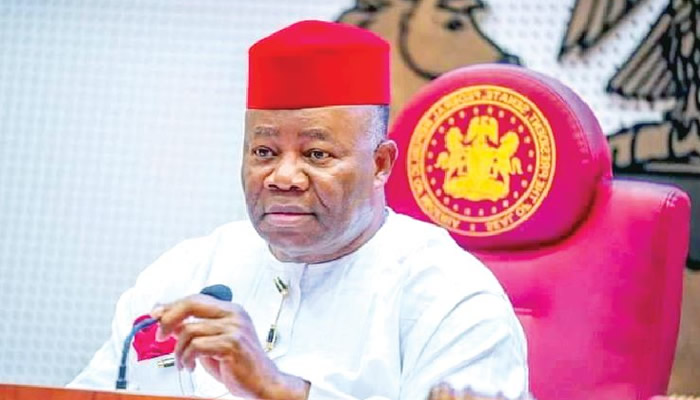
Governor Monday Okpebholo of Edo State has expressed profound admiration for Senate President Godswill Akpabio, lauding his exceptional accomplishments in both governance and legislation. During a reception held in his honor in Akwa Ibom State, Governor Okpebholo declared Senator Akpabio’s achievements in his one-year tenure as Senate President to surpass those of his predecessors who held the office for eight years. He characterized Senator Akpabio’s leadership as unparalleled, particularly highlighting his ability to navigate complex challenges within the Senate while maintaining effective control. Governor Okpebholo’s visit to Akwa Ibom served as a testament to his commitment to emulate Akpabio’s transformative leadership style, which he witnessed firsthand during Akpabio’s governorship of the state.
Governor Okpebholo’s praise for Senator Akpabio centered on the remarkable transformation Akpabio brought to Akwa Ibom State during his tenure as governor from 2007 to 2015. He cited the development of Uyo, the state capital, into one of Nigeria’s most impressive cities as a prime example of Akpabio’s impactful leadership. Okpebholo expressed his firm belief that replicating Akpabio’s development-focused strategies in Edo State would pave the way for similar transformative progress. He emphasized his intention to implement the lessons learned from Akpabio’s successes to drive positive change and enhance the lives of the people of Edo State.
The Edo State Governor’s visit to Akwa Ibom State served as a learning expedition, inspired by Senator Akpabio’s invitation to witness his accomplishments firsthand. Governor Okpebholo recalled Akpabio’s encouragement to emulate the development initiatives he implemented in Akwa Ibom, a challenge he readily accepted. This visit solidified Okpebholo’s determination to borrow from Akpabio’s blueprint for development, adapting and applying its principles to the unique context of Edo State. He expressed confidence that the transformation witnessed in Akwa Ibom was achievable in Edo, reinforcing his commitment to utilizing Akpabio’s model as a guiding framework for his own administration.
Governor Okpebholo’s public acknowledgement of Senator Akpabio’s influence underscored his respect for Akpabio’s leadership qualities. By openly expressing his intention to learn from and replicate Akpabio’s approach, Okpebholo signaled a commitment to proactive and results-oriented governance. He emphasized that Akpabio’s accomplishments were not merely theoretical but tangible and replicable, serving as a source of inspiration and a practical roadmap for his own leadership journey. This admiration for Akpabio’s achievements reflects Okpebholo’s aspiration to achieve similar levels of impactful governance in Edo State.
Senator Akpabio, in response to Governor Okpebholo’s accolades, commended the Governor’s humility and his people-centric approach to governance. He acknowledged Okpebholo’s willingness to seek guidance from experienced leaders as a strong indicator of his potential for success. By welcoming Okpebholo to Akwa Ibom and showcasing his achievements, Akpabio not only demonstrated a commitment to mentorship but also reinforced the importance of collaboration and shared learning among political leaders. This exchange between the two leaders highlighted the potential for positive impact through cross-state learning and the sharing of best practices in governance.
The mutual respect and admiration between Governor Okpebholo and Senator Akpabio emphasized the potential benefits of collaboration and mentorship in political leadership. Okpebholo’s explicit intention to emulate Akpabio’s development-focused strategies signifies a commitment to tangible progress and impactful governance. His visit to Akwa Ibom served as a symbolic affirmation of this commitment, showcasing his proactive approach to learning from successful leadership models. This interaction between the two leaders highlighted the importance of experience sharing and collaboration as valuable tools for enhancing governance and driving positive change within Nigeria’s political landscape.









