





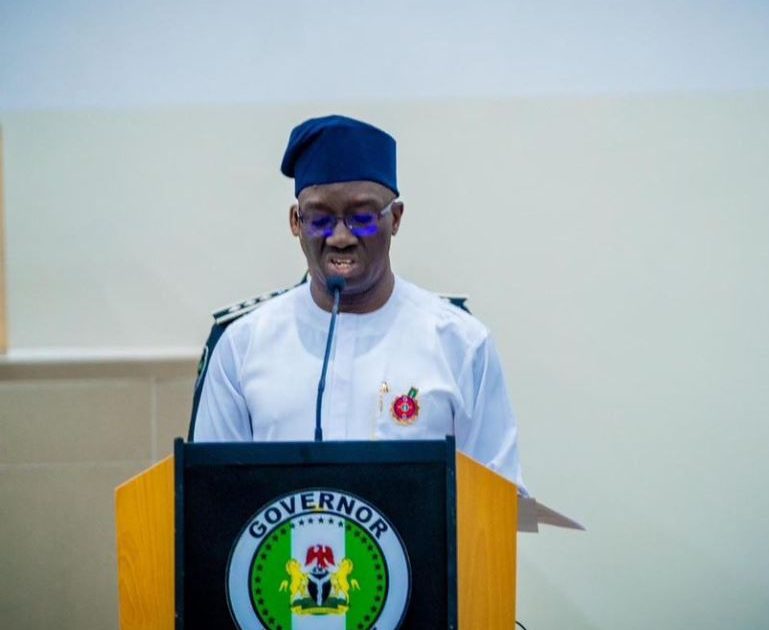
The Edo State Governor, Senator Monday Okpebholo, presented a robust N605 billion budget proposal for the 2025 fiscal year to the State House of Assembly, marking a significant 25% increase from the previous year’s budget. Christened the “Budget of Renewed Hope for a Rising Edo,” the proposal reflects the governor’s five-point agenda focusing on Security, Infrastructure Development, Healthcare, Food Sufficiency, and Education, while also aligning with the Federal Government’s Renewed Hope Agenda. The budget prioritizes capital projects, allocating N381 billion, representing 63% of the total budget, to drive development and transformation across the state. The remaining N223 billion is earmarked for recurrent expenditure. Governor Okpebholo emphasized the budget’s foundation in widespread consultations, ensuring accountability, transparency, and responsive service delivery to the people of Edo State.
A substantial portion of the capital expenditure, N162 billion, is dedicated to road development, addressing the critical need for improved interconnectivity between communities and facilitating economic growth. Recognizing the challenges posed by deteriorating road networks across the state, the governor underscored the administration’s commitment to rectifying this issue. Beyond road infrastructure, the budget outlines plans to modernize Benin City, elevating its status from an ancient city to a contemporary hub. The flagship project in this endeavor is the construction of the Ramat Park flyover, the first of its kind in Edo State, symbolizing the government’s commitment to infrastructural advancement.
Education also receives significant attention in the proposed budget. Acknowledging the decline of tertiary institutions in the state over the past eight years, Governor Okpebholo pledged a monthly subvention of N500 million to Ambrose Ali University, Ekpoma, totaling N48 billion in the 2025 budget, to revitalize the institution. This substantial investment aims to restore the university’s academic standing and contribute to the overall improvement of the education sector.
The healthcare sector receives a substantial allocation of N63.9 billion. The government’s commitment to accessible and affordable healthcare is reflected in the ongoing review of Health Sector Initiatives. Furthermore, N1.8 billion is specifically earmarked for Health Insurance, demonstrating a proactive approach to ensuring broader healthcare coverage and financial protection for citizens. This investment aims to enhance healthcare accessibility and affordability for the people of Edo State.
Agriculture, a crucial sector for food security, revenue generation, and job creation, is allocated N4.5 billion. The focus on farm mechanization underscores the administration’s commitment to modernizing agricultural practices and boosting productivity. This strategic investment aims to strengthen the agricultural sector and enhance its contribution to the state’s economic growth. Moreover, the governor highlighted the importance of resolving inter-communal conflicts, recognizing their detrimental impact on security and development.
The security sector also receives attention, with the recent purchase of 20 patrol vehicles to aid security personnel and plans for further acquisitions in the coming year. The lifting of the ban on the Edo State Vigilante further reinforces the government’s commitment to enhancing security and maintaining law and order. Governor Okpebholo expressed his gratitude to the State House of Assembly for their unwavering support and to President Bola Tinubu for his contributions to the state’s progress. This collaborative approach underscores the shared commitment to the betterment of Edo State. Speaker Blessing Agbebaku reciprocated with praise for the governor’s vision and pledged the Assembly’s full cooperation in ensuring the budget’s timely passage and effective implementation for the benefit of the people of Edo State.








