









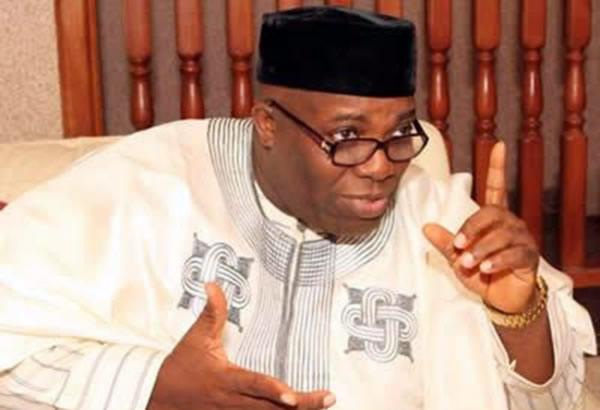
Dr. Doyin Okupe, a prominent figure in Nigerian politics and former spokesperson for Peter Obi’s presidential campaign, has ignited a debate surrounding the 2027 presidential election by asserting that the presidency should remain in the South. Okupe’s argument centers on the principle of geopolitical fairness and the established, albeit informal, convention of rotating the presidency between the North and South. He contends that allowing a northern candidate to succeed President Bola Tinubu, a southerner, after a mere four-year term would disrupt this established pattern and potentially destabilize the delicate ethno-political balance of the country.
Okupe acknowledges the political stature and experience of potential northern candidates, particularly mentioning Alhaji Atiku Abubakar of the Peoples Democratic Party (PDP). He respects Atiku’s qualifications but emphasizes that the prevailing political sentiment, which prioritizes regional representation, poses a significant hurdle for any northern candidate in 2027. The core of Okupe’s argument is not about individual merit but rather the perceived need to adhere to the informal power-sharing agreement that has, for a considerable period, governed the transfer of presidential power in Nigeria. He believes that truncating a southern presidency after only four years would defy this established norm and could be interpreted as a breach of trust, potentially fueling regional tensions.
The former presidential spokesperson further elaborates on the concept of geopolitical considerations in Nigerian politics. He argues that Nigeria, being a nation characterized by significant ethnic and religious diversity, requires a delicate balancing act to maintain stability and foster a sense of inclusivity. The principle of rotating the presidency between the North and South, while not enshrined in the constitution, serves as a crucial instrument in managing these complexities. This unwritten rule, according to Okupe, ensures that both regions feel represented at the highest level of power, thereby reducing the potential for marginalization and promoting a sense of national unity.
Okupe also addresses the potential candidacy of Peter Obi, the Labour Party’s presidential candidate in the 2023 election. While acknowledging Obi’s dynamism and ambition, Okupe believes that unseating an incumbent president, particularly one who is performing well, would be a formidable challenge. He suggests that even if Obi chooses to contest in 2027, the prevailing geopolitical sentiment favoring a continued southern presidency might inadvertently work in Tinubu’s favor. This, coupled with the inherent difficulties of challenging an incumbent, would make Obi’s path to victory particularly arduous.
Furthermore, Okupe delves into the dynamics of political alliances and their potential impact on the 2027 election. Drawing on his extensive experience in Nigerian politics, he expresses skepticism about the effectiveness of political alliances in unseating an incumbent president. He posits that the inherent self-interest of participating parties and their leaders often makes it difficult to achieve the necessary concessions and compromises required for a successful alliance. Okupe highlights the challenge of building trust and maintaining unity within such coalitions, often leading to their eventual disintegration. He cites the frequent failures of business partnerships as an analogy, arguing that similar dynamics often plague political alliances.
Okupe contrasts this with the successful alliance that brought former President Muhammadu Buhari to power in 2015. He attributes the success of that particular alliance to the significant concessions made by Bola Tinubu, a key architect of the alliance. Tinubu’s willingness to prioritize the collective goal over personal ambitions, according to Okupe, was instrumental in forging a unified front that ultimately proved victorious. He questions whether the current crop of opposition leaders, including Atiku Abubakar, Peter Obi, and Rabiu Kwankwaso, possess the same level of commitment and willingness to compromise that would be required for a successful alliance against Tinubu in 2027. Okupe’s skepticism ultimately underscores his belief that the complexities of Nigerian politics, coupled with the self-serving tendencies of political actors, make it highly unlikely for an opposition alliance to effectively challenge an incumbent president.









