





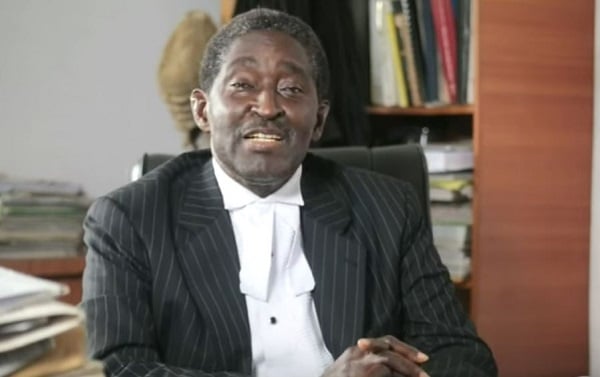
Captain (RTD) Nkrabea Effah Dartey, a seasoned legal practitioner and former Member of Parliament, has vehemently questioned the legal validity and efficacy of the report submitted by the Operation Recover All Loots (ORAL) committee. He argues that the report, despite its presentation to President Mahama, lacks the necessary legal grounding to serve as a basis for prosecuting individuals accused of corruption. Effah Dartey contends that the report can, at best, be considered a preliminary document that might provide leads for further investigation. Its findings, in his view, cannot be directly translated into actionable evidence for prosecution. He emphasizes the established legal principle that prosecutions must be based on meticulously gathered evidence and adhere strictly to due process, standards he believes the ORAL report fails to meet.
Central to Effah Dartey’s critique is his suspicion regarding the hasty establishment of ORAL by President Mahama. He suggests that the speed with which the committee was formed and the subsequent rapidity of its report raise concerns about the thoroughness and impartiality of its investigations. He posits that the primary motivation behind the creation of ORAL was not a genuine commitment to fighting corruption, but rather a politically driven attempt by the President to bolster his public image as an anti-corruption crusader. This perceived political expediency, in Effah Dartey’s view, undermines the credibility and legitimacy of the entire ORAL process and its resulting report.
Effah Dartey further underscores the futility of ORAL’s operations by highlighting the constitutional role of established state agencies in prosecuting corruption cases. He argues that regardless of any findings presented by ORAL, the ultimate responsibility for investigation and prosecution rests solely with these constitutionally mandated bodies. These agencies, such as the Attorney General’s Department, are bound by strict legal procedures and evidentiary standards that the ORAL report, in its current form, cannot satisfy. He emphasizes that the report, lacking the rigor of formal legal investigation, cannot bypass the necessary processes and evidentiary requirements for prosecution.
To illustrate his point, Effah Dartey questions the feasibility of producing a comprehensive and legally sound report on complex corruption cases within the short timeframe in which ORAL operated. He expresses skepticism about the depth and thoroughness of the investigation, given the complexities involved in such cases. Building a robust case against individuals accused of corruption requires meticulous evidence gathering, thorough investigation, and adherence to due process. He implicitly argues that the compressed timeline of ORAL’s operation suggests a superficial approach, thereby precluding the generation of evidence that would stand up to legal scrutiny.
Furthermore, Effah Dartey’s argument rests on the fundamental principle of due process, a cornerstone of any just legal system. He stresses that every individual accused of wrongdoing is entitled to a fair trial, which includes the right to challenge the evidence presented against them. The ORAL report, he argues, having bypassed the rigorous processes of formal investigation and evidence gathering, cannot be considered a credible basis for prosecution as it deprives the accused of the opportunity to effectively challenge the allegations. He maintains that reliance on such a report would constitute a violation of due process rights and undermine the integrity of the legal system.
In conclusion, Effah Dartey dismisses the ORAL report as a legally deficient document that cannot be relied upon for prosecution. He portrays the initiative as a politically motivated exercise designed more for public perception than for genuine anti-corruption efforts. He reiterates the exclusive authority of constitutionally established state agencies to conduct investigations and prosecute corruption cases, emphasizing the legally binding procedures and evidentiary standards that must be followed. He concludes by asserting that using the ORAL report as a basis for prosecution would not only be legally unsound but would also violate the fundamental principles of due process, thereby undermining the fairness and integrity of the justice system.








