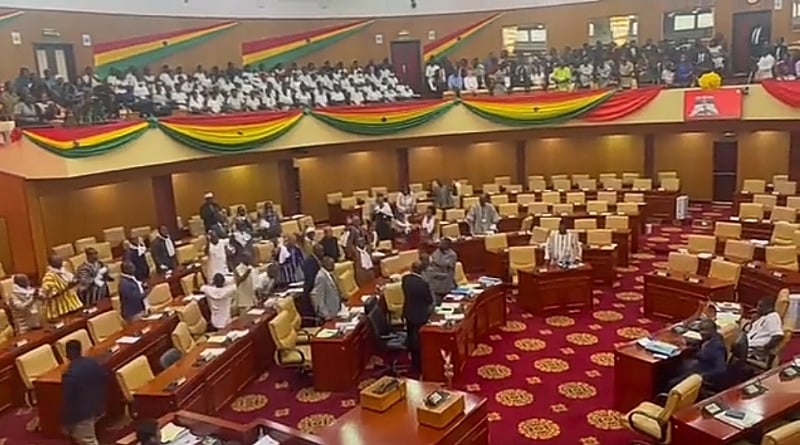
The Ghanaian political landscape is currently embroiled in a contentious debate surrounding the delayed presentation of the 2025 Mini-Budget, a critical fiscal document outlining the government’s economic plans for the upcoming year. Finance Minister Dr. Mohammed Amin Adams’s failure to present the Mini-Budget to Parliament on Thursday, as anticipated, has raised serious concerns about the potential for a government shutdown starting January 1, 2025. This delay has further fueled partisan tensions between the ruling party and the opposition, with each side attributing blame and offering differing solutions to the looming fiscal impasse.
The Mini-Budget serves as a crucial instrument for outlining the government’s economic direction, encompassing revenue generation strategies, expenditure priorities, and plans for fiscal consolidation. It is constitutionally mandated, highlighting its importance in ensuring the smooth functioning of government operations and the provision of essential public services. The absence of this crucial document creates uncertainty and raises questions about the government’s ability to meet its financial obligations in the first quarter of 2025.
Minority Leader Dr. Cassiel Ato Forson has expressed profound disappointment over the Finance Minister’s failure to fulfill this constitutional obligation. He underscored the significance of a seamless transition between administrations and the need for the outgoing government to ensure the continued operation of public services. Dr. Forson criticized the outgoing administration’s handling of the situation, accusing them of acting in bad faith and potentially leaving public services unfunded in the first quarter of the year. He assured the public that the incoming National Democratic Congress (NDC) government, scheduled to take office on January 7, 2025, would address the expenditure needs for the first quarter upon assuming power.
In stark contrast to the Minority’s perspective, Majority Leader Alexander Afenyo-Markin attributed the delay to what he characterized as the “lawlessness” of the Minority group within Parliament. He asserted that the Finance Minister would present the expenditure in advance of appropriation when the House reconvenes on Thursday, January 2, 2025. This conflicting narrative highlights the deep political divisions surrounding the Mini-Budget delay and the broader context of the transition between administrations.
The crux of the matter lies in the timing of the Appropriation Act for 2025, which will not come into effect on January 1st. This creates a legal and procedural gap, necessitating a temporary measure to authorize government spending until the Appropriation Act is passed. The Mini-Budget, which includes the expenditure in advance of appropriation, is designed to bridge this gap and ensure the continued funding of essential government services. The delay in its presentation therefore raises serious concerns about the potential disruption of public services and the stability of government operations.
The current situation underscores the importance of adherence to constitutional mandates and the need for cooperation between political parties to ensure a smooth and responsible transition of power. The delayed Mini-Budget has created a political impasse, with each side blaming the other for the current predicament. The public now awaits the outcome of the parliamentary session on January 2nd and the subsequent actions of the incoming NDC government to resolve this critical fiscal issue and avert a potential government shutdown. The handling of this situation will be a significant test for both the outgoing and incoming administrations and will likely shape the political landscape in the early days of the new government’s term.