





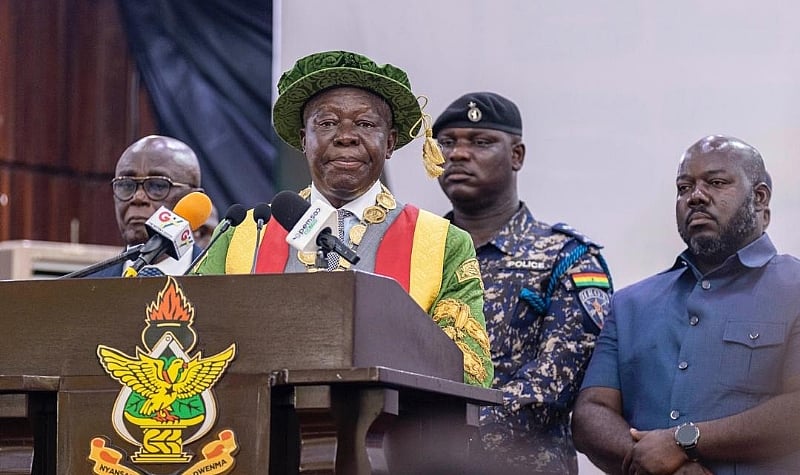
The Asantehene, Otumfuo Osei Tutu II has voiced serious concerns regarding the current political deadlock in Ghana’s parliament, labeling it a “looming danger” that necessitates urgent resolution to avert future crises. Emphasizing the grave potential consequences of the impasse, he noted that entrenched personal grievances impede progress. The Asantehene lamented that political divisions have not only deepened within the nation but have also posed threats to the stability of the wider ECOWAS sub-region. He underscored Ghana’s proud reputation as a pillar of democracy, warning that ongoing political strife could tarnish this image and destabilize the country’s governance structures.
In his remarks during the closing session of the 58th congregation of the Kwame Nkrumah University of Science and Technology (KNUST) in Kumasi, the Asantehene highlighted the growing animosity towards state institutions that are essential for maintaining peace and stability in Ghana. He expressed concern over the challenges faced by the rule of law, indicating a troubling trend among political leaders who seem indifferent to the historical lessons governance has taught about the costs of political miscalculations. He stressed that no form of governance could endure without an effective mechanism for resolving differences and concluding disputes, which is vital not only to constitutional democracy but also reflects the strengths inherent in traditional African governance systems.
Drawing attention to the responsibilities of elected officials, he reminded parliamentarians of their duty to engage in structured debates while also striving for mutual understanding and reconciliation of differing viewpoints. The current political climate, according to the Asantehene, is particularly detrimental and ill-timed. He observed that Ghana’s democracy is still maturing, which makes the country ill-equipped to handle protracted political crises without significant fallout, particularly in light of the economic challenges exacerbated by the COVID-19 pandemic.
The Asantehene further stressed the fragility of Ghana’s economy post-pandemic, asserting that any incoming leadership, regardless of electoral outcomes, will face a daunting task in revitalizing the economic landscape. With global turmoil affecting even the most powerful nations, the implication is that Ghana cannot afford to engage in extensive and unproductive litigations that hinder progress. He urged Ghanaians to recognize that time is of the essence, and every voter should understand that whosoever wins the election must be prepared to act decisively to avert widespread disappointment and unrest.
He cautioned the political factions against operating in isolation, emphasizing that no single party can successfully govern the nation without engaging in meaningful collaboration with the opposition. To ensure effective governance, he argued, a significant degree of bipartisan cooperation is crucial. This approach not only benefits the administrative process but also enhances the stability and continuity of governance in the country. The emphasis on collaboration speaks to the Asantehene’s broader vision for a united national front that can tackle pressing challenges facing Ghana.
Ultimately, Otumfuo Osei Tutu II’s insights reflect a deep commitment to fostering political harmony and stability in Ghana. By highlighting the need for reconciliation and cooperative governance, he calls upon political leaders and citizens alike to prioritize the nation’s collective interest above individual grievances. His words serve as a reminder of the integral role that dialogue, compromise, and mutual respect play in navigating the complexities of Ghana’s political landscape, particularly in these tumultuous times.








