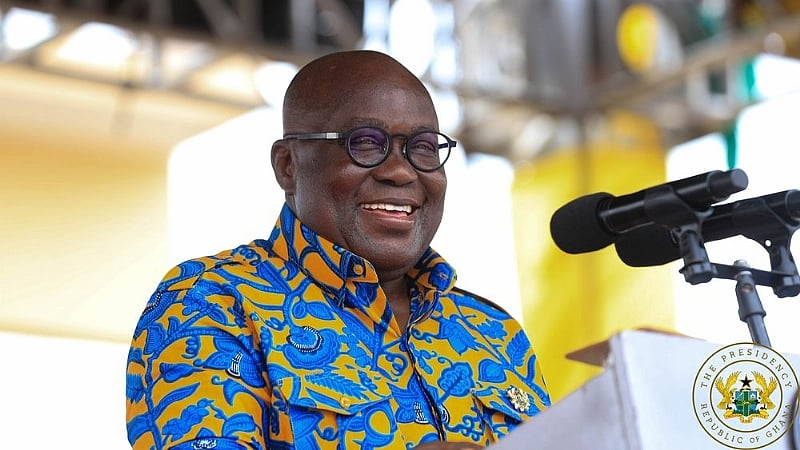
Ghanaian broadcaster Paul Adom-Otchere has expressed high praise for President Nana Addo Dankwa Akufo-Addo, marking him as the most influential politician in Ghana’s 4th Republic. This commendation was made during the launch of his book, “Africa’s New Constitutional Leadership: 77 Stories that Defined Ghana’s 4th Republic,” on November 29, 2024. Adom-Otchere pointed out the profound impact that President Akufo-Addo has had on the political landscape of Ghana, highlighting his significant involvement in landmark events and movements that have shaped the nation. The broadcaster’s insights align well with his book’s themes, exploring critical moments and figures that have contributed to the trajectory of Ghana’s political development over the years.
Adom-Otchere specifically noted President Akufo-Addo’s role in mobilizing supporters during pivotal protests, most notably the ‘Kume Preko’ demonstration in the 1990s, which was aimed at advocating for better governance and democratic reforms. He articulated that Akufo-Addo’s influence extends beyond just his political campaigns and electoral victories; rather, it lies in his ability to mobilize citizens and create a sense of political engagement within the populace. This notion of mobilization is central to the democratic ethos, reinforcing the idea that a vibrant democracy thrives on the active participation of its citizens in political discourse and action.
Elaborating on his praise, Adom-Otchere mentioned the President’s notable campaign efforts in the 1998 Sunyani contest and how these efforts provided momentum for the New Patriotic Party (NPP) in the subsequent 2000 elections. His campaign slogan, “wo mba tsa k3mi” (“we’re changing government”), became a rallying cry for supporters, depicting Akufo-Addo as a central figure in reshaping Ghana’s political narrative. Adom-Otchere highlighted that such significant contributions to political mobilization set Akufo-Addo apart from other politicians of his time, reinforcing his place in Ghana’s democratic journey.
Another aspect of President Akufo-Addo’s legacy that Adom-Otchere underscored was his approach to conciliatory politics, particularly in reference to the 2008 elections. Adom-Otchere commended Akufo-Addo for gracefully conceding defeat with a narrow margin of just 25,000 votes against his opponent. This act of conceding not only demonstrates maturity in politics but also emphasizes the importance of upholding democratic principles, as such behavior fosters trust in electoral processes and strengthens the democratic fabric of the nation. By recognizing the significance of acknowledging electoral outcomes, Adom-Otchere asserts that Akufo-Addo’s behavior has been exemplary in promoting peaceful transitions of power.
In discussions surrounding media plurality, Adom-Otchere credited President Akufo-Addo for championing diversity within the media landscape, especially during election periods. He referenced a landmark case involving the National Democratic Congress (NDC) and the Ghana Broadcasting Corporation (GBC), which resulted in a Supreme Court ruling enforcing equal airtime for all political parties. This move was pivotal in ensuring that various political voices and perspectives could reach the electorate, thereby enriching the democratic environment. Adom-Otchere pointed out that these efforts have played a crucial role in enabling fair and balanced media representation during elections, which is a cornerstone of a functional democracy.
Finally, Adom-Otchere highlighted President Akufo-Addo’s initiative to expand the electoral college of the New Patriotic Party, emphasizing the importance of allowing broader participation in the party’s electoral processes. He recounted that in 2010, Akufo-Addo firmly stated he would not participate in the party’s election unless significant changes were made to broaden its electoral base. This decision signaled his commitment to inclusivity and the democratic principle of expanding the franchise, reinforcing the notion that a vibrant democracy requires active participation from a diverse spectrum of individuals. Ultimately, Adom-Otchere’s reflections during the book launch and the implications of President Akufo-Addo’s leadership underscore a transformative chapter in Ghana’s political narrative, illustrating a comprehensive legacy interwoven with advocacy for democracy, media freedom, and active civic engagement.