





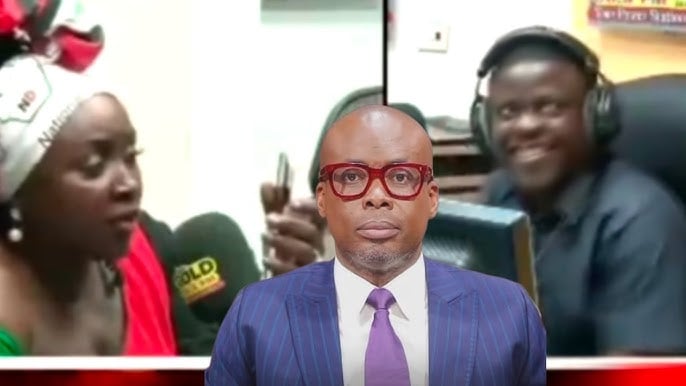
Paul Adom Otchere, a prominent figure in Ghanaian media and politics, finds himself embroiled in controversy following a hasty departure from Ghana to the United Kingdom. His exit, seemingly timed with John Dramani Mahama’s victory in the presidential elections, has fueled speculation and public scrutiny, intensified by the reported loss of his phone at Heathrow Airport. This incident, revealed by Deputy Minister of Food and Agriculture Hanna Louisa Bissiw during a live radio broadcast, has added a layer of intrigue to the narrative. Bissiw’s attempt to contact Otchere on air led to a Heathrow Airport staff member answering the call, confirming that the phone had been found on a plane. The timing of Otchere’s departure and the unusual circumstances surrounding his missing phone have created a whirlwind of conjecture and public discourse.
The unfolding drama surrounding Otchere’s UK trip is further amplified by his pre-election pronouncements, specifically his strong criticism of Mussa Dankwah, the Executive Director of Global InfoAnalytics. Dankwah’s pre-election polls, which predicted a victory for the NDC, were vehemently dismissed by Otchere. He publicly questioned Dankwah’s credibility and the validity of his research methodology, labeling him a “disgrace to the research community.” Otchere’s confident predictions of a significant NDC defeat now stand in stark contrast to the actual election results, providing fodder for critics who see the outcome as a validation of Dankwah’s projections and a rebuke of Otchere’s dismissive stance.
This incident underscores the complex interplay of media, politics, and public perception, particularly in the charged atmosphere of a national election. Otchere’s pre-election commentary, delivered with apparent certainty, now faces the harsh scrutiny of hindsight. His hasty departure, coupled with the lost phone incident, has further fueled speculation about his motives and added to the public discourse surrounding his role and influence in the Ghanaian media landscape. This situation highlights how quickly public sentiment can shift, especially when pre-election pronouncements are contradicted by the eventual outcome.
The narrative surrounding Otchere’s actions is multifaceted, involving not only his public statements and criticisms of Dankwah but also the broader context of the Ghanaian political climate. The timing of his departure, coinciding with Mahama’s victory, inevitably raises questions about his motives and whether his exit was a pre-planned move or a reaction to the election results. The added element of the missing phone, while seemingly a minor detail, has become a focal point of public discussion, contributing to the overall perception of a hurried and perhaps unplanned departure. The convergence of these events creates a compelling narrative that continues to unfold in the public eye.
The public response to this situation reflects the increasing scrutiny faced by media personalities, particularly those who engage in political commentary. Otchere’s strong pre-election statements and his subsequent actions have placed him under the microscope, with many observers questioning his objectivity and motivations. The incident highlights the potential consequences of expressing strong political opinions, especially when those opinions are ultimately proven wrong by the electoral process. The public’s reaction underscores the importance of accountability and transparency in media, particularly in the context of political reporting and analysis.
In conclusion, the saga of Paul Adom Otchere’s UK trip and missing phone serves as a microcosm of the broader dynamics at play in the intersection of media and politics. His pre-election criticisms of Dankwah, followed by the contrasting election results and his seemingly hasty departure, have created a public spectacle. The incident raises questions about journalistic objectivity, the influence of media personalities on public opinion, and the consequences of making strong predictions that are ultimately proven incorrect. This situation serves as a reminder of the power of public scrutiny and the importance of accountability in the media landscape, particularly during times of political significance.








