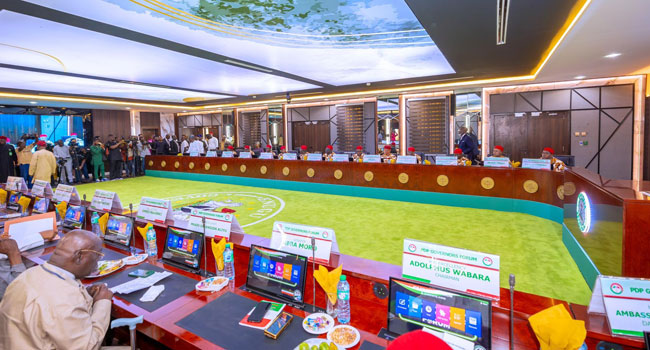
The Peoples Democratic Party (PDP) announced the postponement of its National Executive Committee (NEC) meeting from the initially scheduled date of October 24, 2024, to November 28, 2024. This postponement is strategically aimed at allocating more resources and attention toward preparing for the Ondo State governorship election scheduled for November 16, 2024. The decision emerged from a consultative meeting that involved various organs of the party, including the PDP National Working Committee and the leadership of the National Assembly caucus, as well as former governors associated with the PDP. This meeting took place at the Bauchi State Governors’ Lodge and was led by Bala Mohammed, the Governor of Bauchi State, emphasizing the group’s commitment to effective strategic planning for the upcoming elections.
In a communiqué issued by the PDP Governors’ Forum, the postponed NEC meeting was described as a necessary step to ensure unity and strength within the party as it approaches the Ondo gubernatorial elections. The statement underscored the party’s intent to challenge the ruling All Progressives Congress (APC) by highlighting their struggles in the state. Furthermore, the communiqué called for unity among party members and warned against divisive rhetoric that could hamper the PDP’s preparations and aspirations for the 2027 elections, asserting that internal solidarity is critical in the face of external challenges.
The meeting also served as a platform to publicly acknowledge the leadership of Umar Damagum, the PDP’s Acting National Chairman, with Bala Mohammed expressing support for his role in guiding the party. This comes against a backdrop of legal challenges faced by the party, with factions attempting to disrupt the scheduled NEC meeting. A court order was sought by a faction loyal to Mohammed, reflecting the ongoing power struggles within the party. Notably, an earlier court injunction had barred the PDP from removing Damagum, showcasing the complexities of intra-party dynamics and legal entanglements that could affect decision-making processes and the broader party environment.
While the meeting was geared towards unification and reconciliation, attendance revealed fissures within the party, as only five out of the 13 state governors participated. These included Mohammed and other governors from key states. The participation of a limited number of governors highlights the underlying challenges the PDP faces in solidifying cohesive leadership ahead of crucial elections. Despite these challenges, the leadership expressed optimism about the PDP’s future, emphasizing the need to unify and mobilize effectively against the APC government at both state and national levels.
The importance of the meeting extended beyond immediate election strategies; it symbolized the PDP’s broader commitment to resolving internal disputes and fostering unity as it approaches critical electoral contests. The Olagunsoye Oyinlola-led Reconciliation Committee had previously made strides in resolving disputes within the party’s National Working Committee, indicating a potential for smoother operations moving forward. Mohammed’s remarks during the meeting reinforced a collective resolve to advocate against the emergence of a one-party state in Nigeria while emphasizing the PDP’s legacy as a viable alternative since its inception in 1999.
In conclusion, the PDP’s decision to postpone the NEC meeting signifies a strategic pivot towards maximizing electoral chances in the upcoming Ondo State governorship election. The emphasis on unity amid legal and internal factional challenges highlights the party’s efforts to reinforce its position as the main opposition force in Nigeria. With the leadership rallying around Damagum and a focus on reconciliation, the PDP aims to transform its internal dynamics into a strengthened front capable of contesting the APC’s authority in upcoming elections while maintaining its vision of a pluralistic political landscape in Nigeria.