





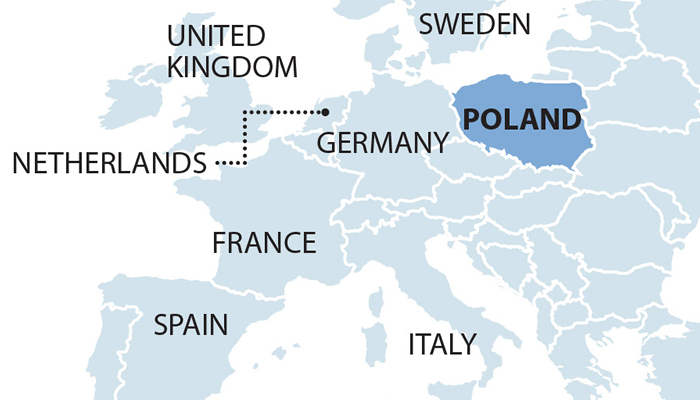
Poland’s recent legislative move to temporarily restrict asylum rights reflects the complex geopolitical landscape on the European Union’s eastern border. The proposed bill, adopted by the government on Wednesday, aims to address the influx of irregular migrants arriving from Belarus, a situation Poland attributes to a deliberate destabilization campaign orchestrated by Belarus and its ally, Russia. This tactic, often referred to as “weaponization of migration,” involves encouraging and facilitating the movement of migrants towards EU borders to exert political pressure and sow discord. The EU, acknowledging the severity of this issue, recently granted member states bordering Russia and Belarus the authority to limit asylum rights under such circumstances.
The heart of the proposed legislation lies in its provision to temporarily suspend the right to apply for asylum for periods of up to 60 days, potentially extendable by another 60 days with parliamentary approval. This suspension would apply to specific border sections designated by the government. Prime Minister Donald Tusk justified the measure as a necessary step to regain control of Poland’s borders, arguing that the right to asylum is being exploited by Poland’s adversaries. The influx of migrants, predominantly from the Middle East and Africa, began escalating in 2021, coinciding with the EU’s sanctions against Belarus for its suppression of opposition movements. This flow intensified following Russia’s invasion of Ukraine in 2022, further exacerbating tensions in the region.
The migrant crisis has placed Poland, a staunch supporter of Ukraine and a member of both NATO and the EU, in a precarious position. The country has become a frontline state grappling with the consequences of regional instability and geopolitical maneuvering. While the government emphasizes the need to protect its borders and national security, the proposed legislation raises concerns about potential human rights implications and the erosion of international asylum protections. Critics argue that restricting asylum access, even temporarily, could deny vulnerable individuals fleeing persecution and conflict the opportunity to seek refuge.
The backdrop to this legislative development is the ongoing tension between the EU and its eastern neighbors, particularly Belarus and Russia. The EU accuses both countries of orchestrating the migrant flows to destabilize the bloc, while Belarus and Russia deny these allegations. The situation is further complicated by the ongoing war in Ukraine, which has led to a significant increase in refugees seeking safety in neighboring countries, including Poland. This adds another layer of complexity to the migration challenges faced by Poland and other frontline states.
The proposed law’s trajectory now hinges on parliamentary approval, where Tusk’s coalition government holds a majority. However, the bill faces internal resistance, particularly from The Left, a junior coalition partner, which has voiced reservations about the measure. This internal dissent underscores the complexities and sensitivities surrounding the legislation. Even with parliamentary approval, the bill requires the president’s signature to become law, adding another potential hurdle.
Beyond the asylum restrictions, the Polish government also adopted other measures concerning foreign nationals, including a tightening of the visa allocation system. This broader approach suggests a concerted effort to strengthen border control and regulate the entry of foreigners into Poland. These measures reflect the Polish government’s determination to address the challenges posed by irregular migration and reinforce its border security, even if it means temporarily curtailing certain asylum rights. The long-term impact of these measures on migration patterns and the human rights of asylum seekers remains to be seen.








