





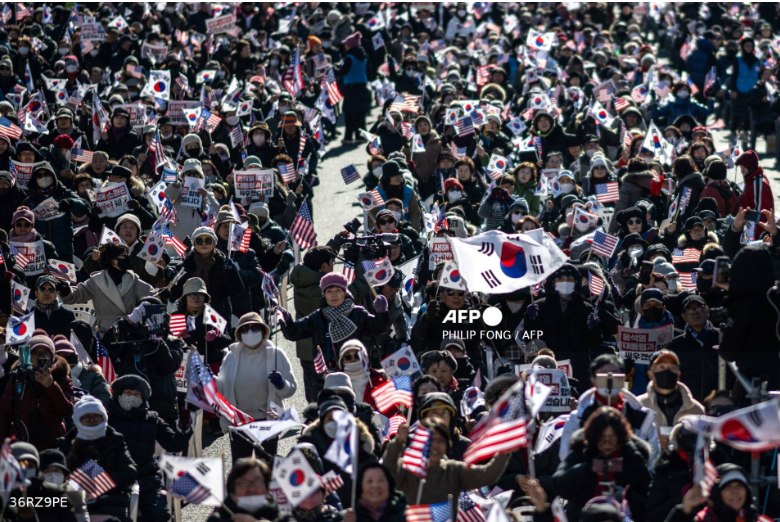
The political landscape of South Korea has been thrown into disarray following a dramatic standoff between investigators attempting to arrest suspended President Yoon Suk Yeol and his staunch defenders. Yoon, impeached and suspended last month following a controversial and ultimately failed attempt to impose martial law, faces charges of insurrection, a crime that bypasses presidential immunity and carries severe penalties, including the death penalty. The attempt to execute the arrest warrant, which expires on Monday, was thwarted by a formidable barrier of presidential guards and military personnel, numbering approximately 200, who physically blocked investigators from accessing Yoon’s residence in Seoul. This unprecedented confrontation has left the nation in a state of uncertainty, with the future of the presidency and the stability of the country hanging in the balance.
The failed arrest attempt marks the culmination of weeks of mounting political tension. Yoon, a former star prosecutor, has been holed up in his official residence since his impeachment, refusing to cooperate with investigators seeking to question him regarding the martial law decree. The Corruption Investigation Office (CIO) responsible for the investigation confirmed the standoff, citing safety concerns as the reason for abandoning the operation. The investigators reported a dangerous situation, heavily outnumbered and facing the possibility of further escalation. The scene underscored the deep divisions within the country and the extraordinary lengths to which Yoon’s loyalists were willing to go to protect him.
The legal implications of the standoff are complex. The warrant’s imminent expiration necessitates a decision by the CIO on whether to seek a new warrant or pursue alternative strategies. The Constitutional Court is scheduled to begin Yoon’s impeachment trial on January 14th, a proceeding that can continue in his absence if he chooses not to appear, setting a precedent followed by former presidents Roh Moo-hyun and Park Geun-hye. Yoon’s legal team has vehemently denounced the arrest attempt as unlawful, promising legal action. Furthermore, two high-ranking officials from Yoon’s security detail have refused to comply with police summons for questioning, citing their primary responsibility to protect the suspended president. This defiance further complicates the situation and highlights the potential for protracted legal battles.
Adding another layer of complexity, experts suggest that investigators may strategically delay further attempts to arrest Yoon until after the Constitutional Court delivers its verdict on the impeachment motion. This would potentially remove the complexities of arresting a sitting, albeit suspended, president, simplifying the legal process. Meanwhile, South Korean media has reported that the CIO’s initial plan involved transporting Yoon to their Gwacheon office for interrogation, potentially holding him for up to 48 hours under the existing warrant. Any extended detention beyond that period would have required a new warrant. These details reveal the intricate legal maneuvering surrounding the case and the challenges investigators face in navigating the unprecedented circumstances.
The political fallout from this standoff has been significant. Yoon has maintained a defiant stance, vowing to fight for his political survival and rallying his right-wing supporters. His refusal to cooperate with the investigation and the dramatic resistance mounted by his security forces have deepened the political chasm within the country. The events underscore the fragile state of South Korean politics and the potential for further instability. International concern is also mounting, with key allies like the United States urging South Korea’s political leaders to find a “stable path” forward.
The incident has far-reaching implications beyond domestic politics. The United States, a crucial security ally to South Korea, has expressed concern over the unfolding situation, emphasizing the importance of stability and reaffirming its commitment to the bilateral relationship. Outgoing Secretary of State Antony Blinken’s upcoming visit to Seoul underscores the gravity of the situation. His talks will undoubtedly address the political crisis and its potential impact on regional stability, particularly concerning North Korea’s nuclear ambitions. The standoff involving President Yoon has thus become a matter of international concern, adding another layer of complexity to an already delicate geopolitical landscape.








