





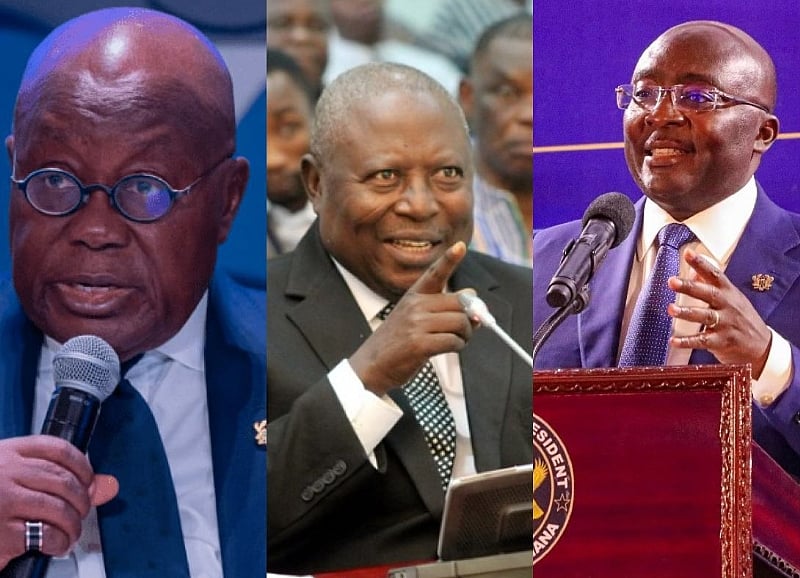
Former Special Prosecutor Martin Amidu has expressed sharp criticisms against the ruling New Patriotic Party (NPP) in Ghana, targeting President Nana Addo Dankwa Akufo-Addo and Vice President Dr. Mahamudu Bawumia. In a recent opinion piece, Amidu accuses the current administration of being “corrupt” and “power-drunk,” suggesting that they hold a dismissive attitude toward the Ghanaian populace. He argues that the government views the average citizen as easily manipulable, claiming they believe that Ghanaians can be swayed simply through superficial acts or gestures. This characterization reflects a broader disdain for the electorate, as Amidu posits that the ruling party underestimates the intelligence and political agency of voters.
In his critique, Amidu highlights the timing of recent government project commissionings, labeling these events as an abuse of incumbency. He suggests that these initiatives are not genuine acts of governance but rather strategic moves aimed at obscuring the administration’s economic and social failures in the lead-up to the December 2024 elections. Amidu’s concern centers on the idea that these commissioning events are being staged to deflect attention from the pressing issues affecting citizens, thus undermining the essence of democratic engagement. His rhetoric implies that such tactics are designed to manipulate public perception rather than represent authentic efforts to address the needs of the people.
The commentary also touches on the broader implications of these practices for democratic integrity in Ghana. Amidu posits that President Akufo-Addo is afraid of a truly competitive electoral process. He asserts that this fear is manifesting in the strategic reserve of major infrastructural projects to be officially inaugurated as the election nears. This tactic, he argues, demonstrates a lack of faith in the democratic process, revealing an administration that relies on spectacle rather than substantive governance. According to Amidu, the government’s actions indicate a calculated approach to retain power, demonstrating a disconnect from the principles of democracy which rely on fair competition and transparency.
Amidu’s language underscores a deep frustration with how the current political landscape treats the electorate. He describes the government’s strategy as a “condescending insult to the electorate,” implying that these overtures are not merely ineffective but also degrading, reducing the complexities of democratic choice to superficial displays. The former Attorney General’s statements reflect his belief that the ruling party is prioritizing its political survival over the genuine needs and rights of the citizens. This perspective challenges the very foundation of democratic governance, which should ideally empower the populace rather than exploit their preferences for electoral gain.
Furthermore, Amidu’s argument about the misuse of public funds framed as development initiatives raises significant ethical concerns about governance in Ghana. He insists that the government’s actions are not only politically motivated but also ethically dubious, as they divert public resources to serve partisan ends. The conflation of public service with political manipulation poses challenges to accountability in government and further erodes public trust. Amidu’s critiques call for a reevaluation of how political leaders engage with citizens, advocating for a more honest and transparent approach that aligns with the principles of democracy.
In conclusion, Martin Amidu’s opinion piece is a fervent indictment of the NPP administration, encapsulating overarching themes of corruption, electoral manipulation, and the ethical responsibilities of leadership. His assertions argue that the ruling party’s approach to governance and elections disrespects the electorate and undermines democratic principles. As the December 2024 elections approach, Amidu’s observations serve as a crucial reminder of the need for responsible leadership that prioritizes the welfare of citizens over political expediency. The dialogue initiated by Amidu is an important contribution to the ongoing discourse regarding governance and democracy in Ghana, emphasizing the need for accountability, integrity, and respect for the electorate in the political arena.








